
AI Assistant
Hello, how can I help you?
Welcome to the STRIDE AI Assistant
Get instant, evidence-based answers directly from our European database. To get the most accurate results, follow these 3 golden rules when asking your questions:
Prompt Examples
Inspiration
Get inspired by these ready-to-use prompts. Copy and adapt them to query the database effectively:
User Tip: Want to copy generated tables?
You can mark any table directly in the AI Assistant's answer and copy it. Open Microsoft Excel or Google Sheets and paste it directly. You may need to do minor adjustments to columns and rows.
AI Assistant Chat Window
Overview of the technical setup of the AI Assistant
Below we describe how the Toolbox’ AI Assistant has been built
The toolbox AI Assistant is a RAG-model (Retrieval-Augmented Generation model) and its architecture can be explained this way:
1. Evidence-based data foundation:
Expanded and validated research material comprising peer-reviewed reports (e.g., STRIDE D2.1 and D3.1), legislation, and national case studies.
2. Semi-structured JSON encapsulation (Structured Metadata Indexing):
Each section of the research is tagged with structural metadata (ISCED levels, country names, reform types, years, source references).
3. Vector-based semantic search (Vector Search/RAG):
The AI assistant does not search the internet at random; instead, it derives its answers exclusively from this closed, quality-assured knowledge repository.
Summary
We have a closed, evidence-based RAG repository where high-quality research from PDFs and Word documents has been structured and enriched with metadata (JSON), enabling the vector database to retrieve relevant expert knowledge with pinpoint precision.
The illustration below shows an overview of the AI Assistant is built. It is important to highlight that the AI Assistant only has access to content available and used in the toolbox, including reports, European reform data (also to be found in the Interactive Map), the national cases and briefs.
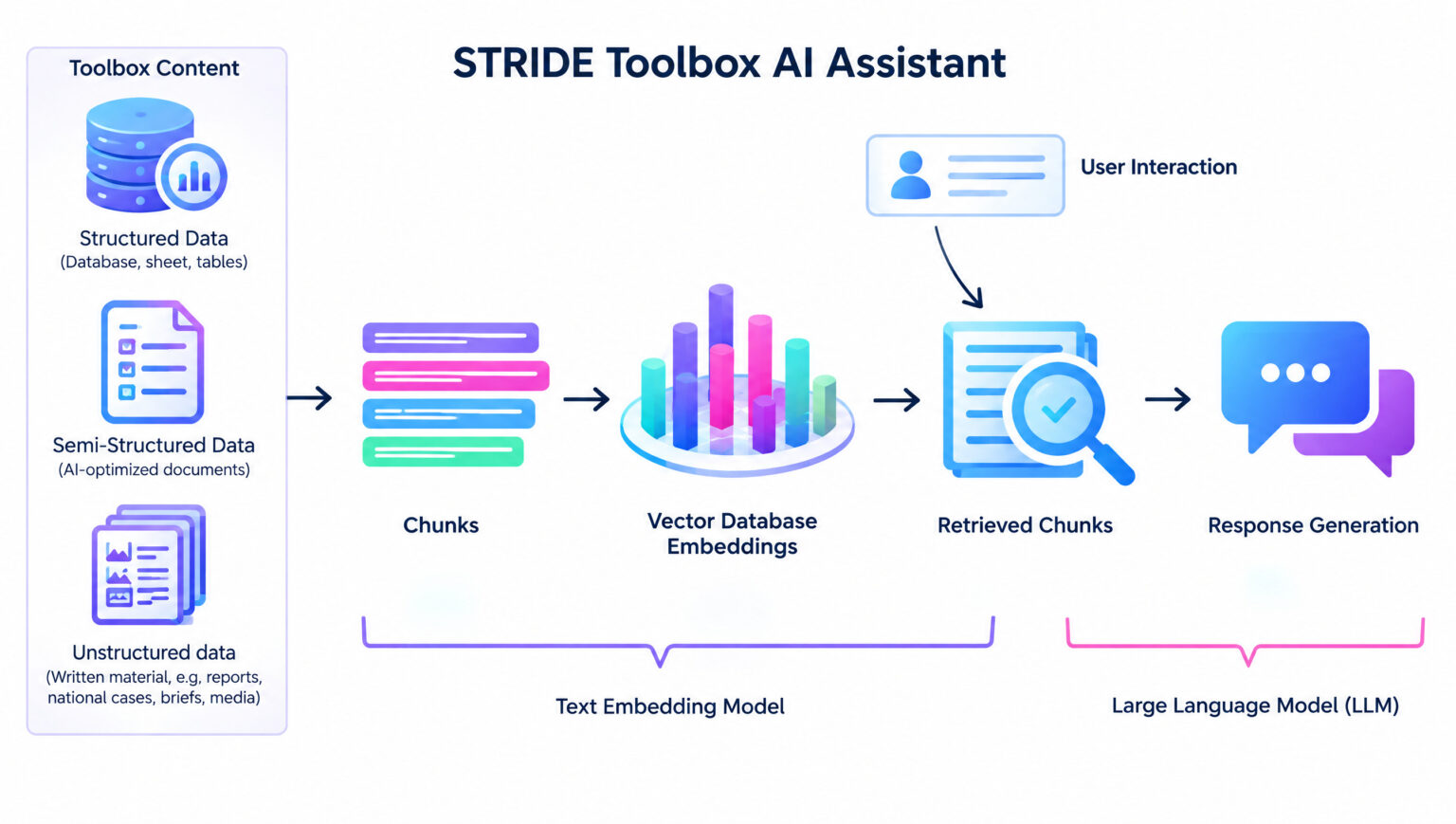
Unstructured data cover content consisting of ordinary human language text (sentences, paragraphs, reports, analyses, articles). Even though the text in a research report is incredibly well-structured to the human eye (with chapters and headings), computer scientists call it “unstructured” because a traditional SQL database cannot look up an arbitrary sentence as if it were a postal code.
Semi-structured data are a hybrid. We have taken the “unstructured” free text from the reports and wrapped it in a structured container (JSON) with fixed fields: id, chapter, ISCED-level, topics, and text.