
Home/
Policy and Reforms
Introduction
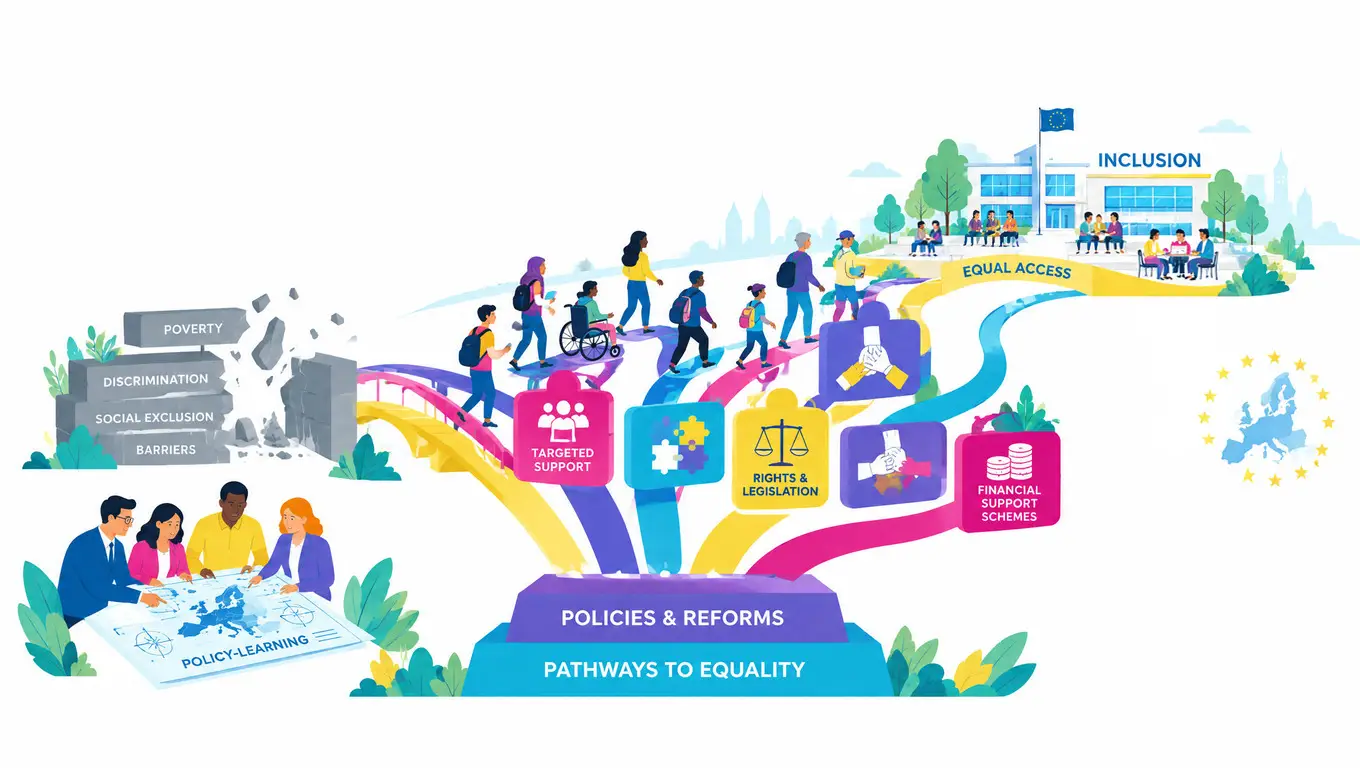
The examples presented under “Policy and Reforms” should not be seen as ready-made solutions for replication.
Educational reforms are shaped by specific institutional, cultural, social, and economic conditions, meaning that successful policy adoption requires adaptation to local contexts.
The value of the examples of reforms presented here and in the STRIDE Toolbox therefore lies not in promoting direct transfer, but in supporting informed, evidence-based, and context-sensitive policymaking aimed at reducing educational inequalities.
The overview presented below offers a concise insight into how you can work with policies and reforms from across the European region using this STRIDE Toolbox.
Addressing Educational Inequalities: Educational inequalities remain a key concern across Europe. While national approaches vary, recent reforms increasingly combine targeted support for vulnerable groups with broader commitments to inclusion, equal access, and participation throughout the life course.
The toolbox illustrates the diversity of approaches used across Europe to address barriers linked to socio-economic status, geography, ethnicity, and disability.
Key Target Groups:
Rather than relying on a single mechanism, European countries deploy a variety of policy pathways to reduce educational inequalities:
- Legislative Reforms: Rights-based interventions and mandatory frameworks.
- Financial Schemes: Targeted funding and equity grants.
- Outreach Programmes: Inclusion measures and proactive engagement.
- Welfare Approaches: Comprehensive, holistic support systems.
This toolbox serves as an active policy-learning resource designed to support evidence-based decision-making:
- Explore how similar challenges are addressed in different contexts.
- Compare implementation mechanisms and long-term outcomes.
- Identify effective policy elements to inform future developments.
Context-Sensitive Adaptation (Not Direct Replication)
The selected examples should not be seen as ready-made solutions for direct copy-paste replication. Educational reforms are deeply shaped by local institutional, cultural, and economic conditions. Their core value lies in supporting informed, context-sensitive policymaking.