Welcome to the STRIDE Toolbox
Please note: The STRIDE Toolbox Site is under construction.
Welcome to the STRIDE-project and the STRIDE Toolbox
You are in the right place if...

The STRIDE-project in brief
Strategies for Achieving Equity and Inclusion in Education
Our Goal & Methodology
STRIDE achieves this through rigorous analyses of education reforms within national and regional systems, utilizing existing large-scale educational assessments and longitudinal data. By examining the causal links between educational tracks and broader social policies, we map out what shapes educational achievements over time.
Through close collaboration with national and European stakeholders, STRIDE develops advanced methodologies and assessment tools for policy learning. Our goal is to demonstrate the immense value of longitudinal evidence, offering policy-makers actionable knowledge to mitigate educational inequalities in the short, medium, and long term.
Intersectional Lens
We closely examine the range of overlapping variables which may affect learning outcomes in different ways across different European contexts:
STRIDE Project Stages

Stage 1: Mapping Trends

Stage 2: Effective Policy

Stage 3: Practical Tools
The STRIDE-project and the STRIDE Toolbox
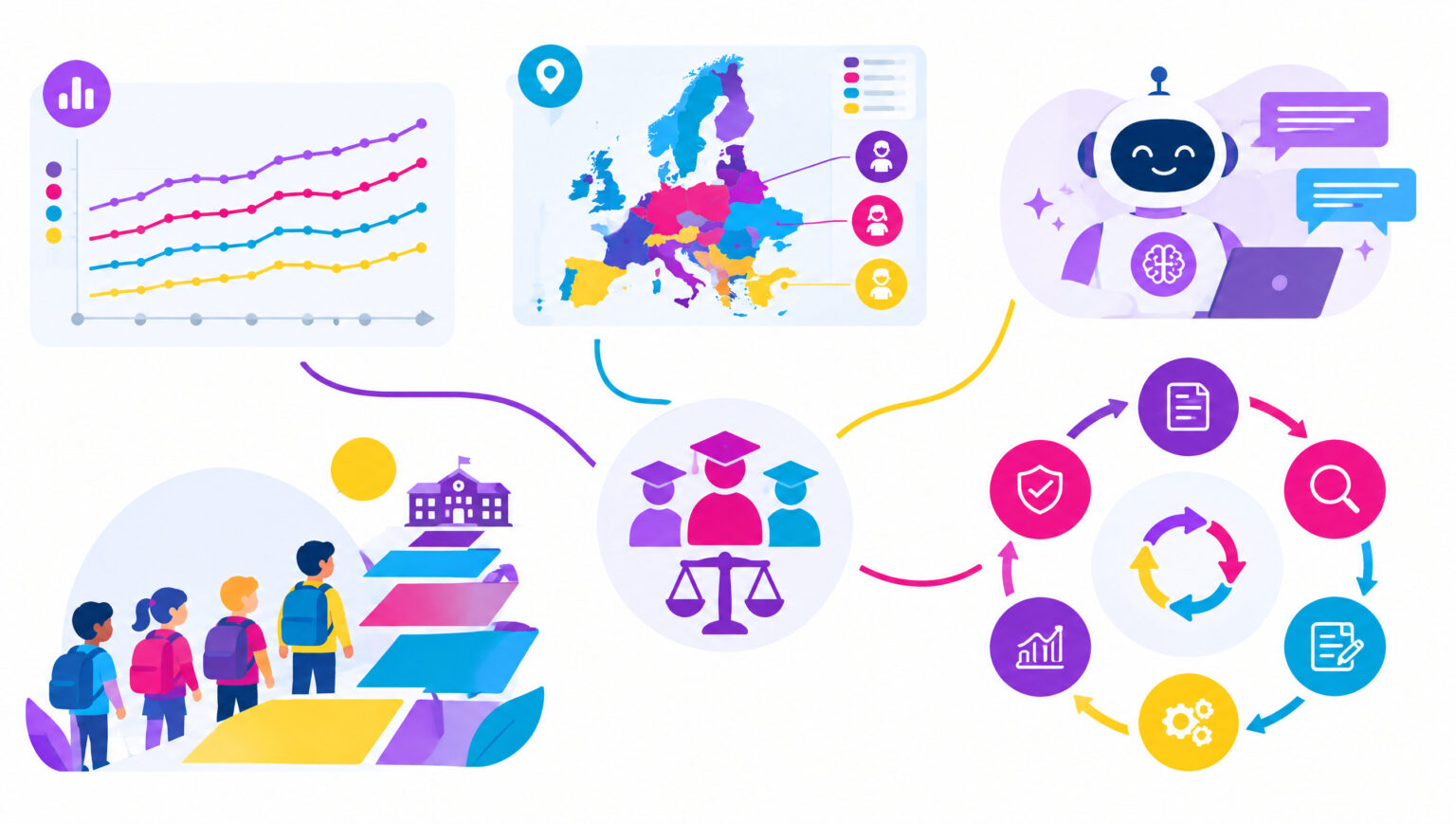
The toolbox is based on the research outcomes of the STRIDE project and brings together enhanced knowledge on what shapes educational outcomes over time – and provides valuable longitudinal evidence to be applied in policy making to create fairer learning opportunities for all.
The toolbox includes:
- Smart techniques for facilitating cross-sectoral policymaking and assessment of inequalities in education, training and learning outcomes over time using longitudinal data on learning.
- An interactive digital map of significant factors and trends of inequalities in education and educational outcomes across Europe.
- An AI Assistant is ready to assist you with your research and policymaking tasks in the field of education, based on content available in the toolbox.
- Concrete reform examples of how to use the Policy Cycle, a tool for driving the policymaking process in education step-by-step, from problem identification to successful implementation, evaluation and maintenance.
The STRIDE Toolbox structure
About the Toolbox Structure:
In designing the toolbox, we aimed to accommodate a workflow where you might use it to quickly gain inspiration and an overview regarding reform efforts.
At the same time, there are ample opportunities to explore the material in greater depth, both via the interactive map and the AI Assistant.
Furthermore, we have focused on making the pages as mobile-friendly as possible, while ensuring compliance with technical accessibility requirements.
Note: You can click on the individual points in the diagram to go directly to that point.
How to work with the STRIDE Toolbox
1: The Trigger (The Dilemma)
Example: You as a policymaker or a knowledge broker need to address educational inequality under a tight budget. You ask: “What has worked in peer countries, and what bottlenecks should we avoid?”
2: The Filtering (AI Assistant, Search, Toolbox Reads)
Example: Instead of reading hundreds of pages, you use Search to filter the documents in Toolbox Reads by topic (e.g., ECEC) and specific institutional challenges.
3: The Deep-Diving (AI Assistant at Work)
Sample: You ask the STRIDE Toolbox AI Assistant for a direct comparison: “Table of implementation issues in Norway vs. England during Agenda Setting.” The AI extracts the exact insights from the research documents instantly.
4: The Evidence-Based Output
Sample: You copy the AI Assistant’s replies and download a targeted document (a case study, a policy reform overview). You now have solid, research-backed arguments and risk assessments ready for the upcoming policy brief.
Click here to read the Quick User-Guide – the easy way to get started!