
Summary
Context
In 2008, Poland had the lowest preschool access indicators in the European Union. Moreover, regional and local disparities in access to preschool services were severe and negatively impacted developmental inequalities among children at both the international and national levels.
This situation resulted from the post-socialist transition, during which preschool education was decentralised and transferred from the central government to local authorities. This shift, combined with economic restructuring and financial constraints at the municipal level, led to a substantial decline and stagnation in the number of preschools, particularly in rural areas.
Since the late 2000s, a combination of factors — including the European Union’s agenda and funding, NGO initiatives, growing public support, and increasing political commitment — has driven a number of significant reforms aimed at expanding access to early childhood education and care (ECEC) across the country, with a particular focus on underserved rural regions.
Reforms
Poland implemented a series of rolling policy changes to expand access to preschool education. This multifaceted reform, implemented between 2008 and 2017, gradually introduced several key measures:
- Diversification of preschool provision,
- A statutory guarantee of preschool places for all 3- to 6-year-olds
- An expansion of the number of preschool institutions and available places, and
- Improved affordability of early childhood education through the partial elimination of fees
It should be noted, however, that the above initiatives did not constitute a planned, coherent programme of reforms but rather unfolded amid changing political landscapes.
The Policy Cycle
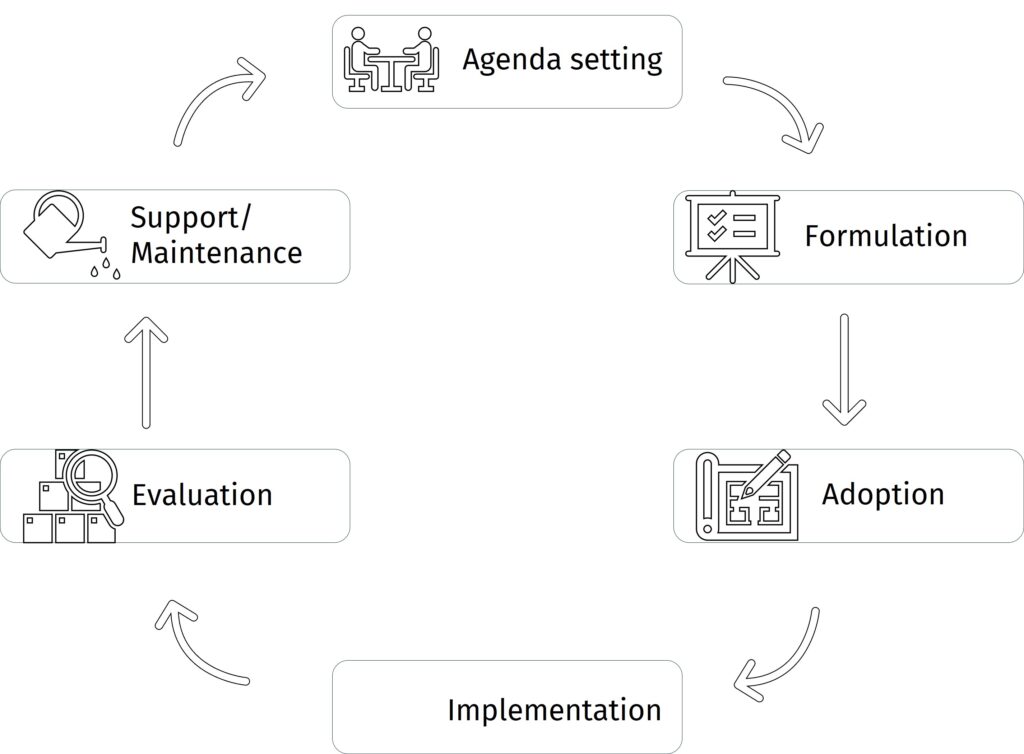
Agenda Setting
Problem
Low access to preschool education, with further inequalities at the regional and local levels (the northern, north-eastern, and eastern parts of Poland were less urbanised, with higher poverty and unemployment levels and lower preschool access).
Target groups
Children aged 3 to 6 across the country, with a particular focus on the most underserved rural regions.
Political context
Need to increase preschool access, initially driven by women’s employment activation agenda rather than removing barriers for children (Lisbon strategy). With time, a universal preschool education was recognised as a key equalising measure for children’s academic achievement, particularly for those from socio-economically disadvantaged backgrounds, socially excluded communities, and with special educational needs.
Evidence base
The assumption that universal preschool participation from a young age has a positive impact on children’s socio-emotional development and educational outcomes. The third sector strongly promoted the benefits of ECEC, as it was a low priority, especially at the beginning of the transformation period in the 90s and 2000s.
Formulation and Adoption
Main measures
Gradual expansion of access to preschools for all 3- to 6-year-olds across the country
Legislative instruments
- Diversification of preschool provision (allowing for alternative organisational forms of kindergartens, both public and non-public; 2008)
- Five hours of free preschool provision plus subsidised (very) low cost of additional hours (since 2013)
- (Gradual) statutory guarantee of preschool place for every child aged 3-6 (between 2014 and 2017)
Implementation
Geographical scope
- Across the whole country, especially in underserved rural areas – gradual universal measures
- Target group and intake: Gradual focus on 3 to 6-year-old children
Actions
- Development of the necessary infrastructure (building, expanding, and converting existing public facilities into preschools), mostly by the third sector in collaboration with local authorities – the availability of the EU funding was a key enabler
- Growing support and understanding of the importance of ECEC amongst key stakeholders (local authorities, central government, public, media) and local communities, especially in rural areas
- ECEC became recognised as key on the local authorities’ agenda. As a result, municipalities decided to continue EU-funded, third-sector-led preschools using their own budgets and state subsidies. Such engagement of local authorities became an important step toward the sustainability of preschool education, especially in rural areas.
Evaluation
Missing evaluation
Lack of systemic/long-term evaluations of the reforms by the government and public institutions
Small-scale evaluations
Conducted by third sector/researchers/public institutions (often driven by the requirements for the EU-funded projects)
- These evaluations showed diverse positive effects: on children’s development, wellbeing, educational outcomes and opportunities as well as on local rural and disadvantaged communities (revitalisation, intergenerational engagement, cohesion, employment opportunities, especially for women)
- The recruitment system also supported large and/or disadvantaged families. The guarantee of a place forced local governments to create additional preschool places (for example, temporary preschool preparatory classes were also organised in primary schools when there were not enough places available)
Support/Maintenance
Maintenance
The sustainability of ECEC provision was ensured by taking over EU-funded, third sector-led preschool provision by local authorities (using their own budgets and state subsidies)
Results
Access to ECEC has increased significantly over the years, from fewer than 300–500 children per 1,000 (depending on the region) in 2002 to nearly full coverage by 2023.
Current challenges: Some (new and old) inequalities continue to exist:
- Rural-urban divide in access and learning outcomes later in life
- Quality of ECEC provision
- Quality of curriculum
- Proliferation of elite preschools
- Ensuring inclusive education
- Demographic changes and preschool closures
Success Stories
Success Story # 1: EU funding, political will and LA engagement
The civil servants were open to it [supporting activities aimed at increasing access to ECEC] because the policymakers simply allowed them to be — there was a genuine willingness to implement this change. At the same time, a new perspective opened — the possibility of securing further funding. […] but you know, that political will was there because, in light of the well-known gap in access to preschool education, third sector organisations stepped in.
They secured [EU] funding, established preschool centers, and those centers turned out to be a great success in terms of improving access to early childhood education services. And now, with these small preschools already up and running, there was a need to ensure stable, long-term funding for them. (Researcher in ECEC policy and education governance).
And it was not yet at the stage, in 2007, for ECEC to be so important here (in local authorities). Today, it is completely different: preschool education is a priority; these are conscious decisions by mayors; today, the education of young children is a priority. (ECEC teacher and a local activist)
Success Story # 2: Multidimensional positive impact of expansion of ECEC
- Children’s development,
- Wellbeing
- Educational outcomes and opportunities as well as local communities (revitalisation, intergenerational engagement, cohesion, employment)
We had surveys directed to parents, and professional ones done by the Foundation. ‘The classes in the kindergarten club gave my child a lot; there is no problem when he is in a new group, he is not ashamed, and he has the courage to talk to others about some topics from kindergarten.
It is one mother, then the other one – ‘the child develops every day, wants to know more, has a lot of questions related to learning about the world around them and from what they have heard in the kindergarten club’. That’s from interviews with parents.
‘They acclimate to school faster, they are bolder, more active, they can cooperate with others, and they take the initiative. They are very active in play’, that’s what the teacher said.
‘They are more creative in transforming the materials they have, they operate them more boldly. Children have better mastered the movements of their hands and fingers, which is important for writing. They have greater knowledge of the world and learn more easily and faster. They are more analytical’. (Mayor of a rural local authority).
Children who were very difficult and I would say, well, weak, because they entered this stage of education very late, for example, as four- or five-year-olds. They are doing great today.
One told me, ‘I’m going abroad, I have a car, I live nicely, so. Some of them also started families and have children. As I observe, and sometimes I say, ‘Listen, how are you doing? Do you remember me from kindergarten?’
And they say that when ‘we were so little, we played with paints. And you know, I paint now, because that’s how it was then, that these paints were so accessible [in kindergartens], and at home, my mum never let us get dirty. Well, I remember those were good times’. (ECEC teacher and a local activist)
Success Story # 3: Do they see any changes and progress in their children’s development?
We [third-sector] also talked to the parents about whether they see any changes and progress in their children’s development.
From the moment they came to the preschool. And that’s when the discussions started. And the positive changes started. And the conversations started about the children.
Suddenly, the parents were discussing, it wasn’t gossip, what the heck, who saw whom, where and so on, because up until now these were the types of points of interest.
Suddenly, it turns out that our children were the centre, right? The methods of work [with children]; the parents appreciated very much throughout the project. […].
[W] We worked using the research project method, and the teachers always informed the parents since we were talking about pasta, so one mother brought pasta, so we would cook it. […] another one came up with the idea that we can go, because there is a bakery nearby. Or a bank, where we talked about money or to the garden, where one of the grandparents planted beautiful trees a long time ago.
It turns out that, well, everyone asked us about these children and for sure, what kind of group is this? And so it turned out that everyone knew that the EU kindergartens function, children go to the EU kindergartens. (ECEC teacher and a local activist)
Success Story # 4: Recruiting teachers locally from each county, from every municipality
We recruited teachers locally from each county, from every municipality. It was important to us that the teachers working in a given area were actually from that specific municipality.
That turned out to be an incredible source of motivation — and also a strong incentive for the local mayors. […]
We trained the teachers. These were unemployed teachers — women registered at job centers, waiting for work. Sometimes they were the sole breadwinners for their families.
These women were suddenly given a small piece of the world they could call their own, a space where they could shine and show their best selves — and they were paid for it.
So they were incredibly motivated to work. (ECEC teacher and a local activist).
Barriers And Enablers
Enablers
- EU Funding and agenda
- Third sector and local communities’ engagement
- Public support
- Political will
- Stable public funding
Barriers
- EU Funding (short-term, bureaucracy, reporting)
- Education as a political battlefield
- High levels of bureaucracy and legislative challenges (State and local levels)
- Lack of/limited consultations/co-production with the key stakeholders across policy cycle
- Lack of longitudinal data on ECEC impact on outcomes and opportunities
- Lack of (systemic/state-level) evaluations of the policy/interventions
Potentials for transfer to other (national) contexts: lessons learnt
The expansion of preschool access in the last two decades has been a non-linear, interdependent, and complex process, shaped by multiple layers of influence and barriers:
- Political will and public support for specific policies/interventions (in this case, expansion of preschool access)
- Secured public funding available for diverse forms of ECEC
- Education as an area excluded from the political rivalry/conflict; long-term planning, coherent, holistic thinking of education/educational stages (they are connected), without sudden, non-evidence-based, politically-driven changes
Best results when:
- Key stakeholders are included as co-producers at every stage of the policy cycle
- Policies are allowed to settle, and their effects can be evaluated in a systemic way – positive effects take time to be visible
- Evidence-based improvements/modifications are carried out based on these systemic evaluations (not political rivalry)