
3. Key Features Overview
This section provides an overview of key structural features and recent reform activity across the educational systems of 29 countries. It outlines patterns in compulsory education, public schooling and tuition fees, private school attendance, and the degree of centralisation and decentralisation in school decision-making. Additionally, the section examines reform trends, their distribution across ISCED levels, types of reforms, and the extent to which reforms have been evaluated. By providing a comparative overview, this section highlights differences and commonalities in European education systems and sets the stage for further analysis of how structural characteristics and reform strategies may influence educational equity, inclusion, and quality outcomes.
3.1 General Overview of Educational Systems
3.1.1 Compulsory Education
National educational systems of 27 EU countries, Norway, and England are described in the following. The three communities of Belgium are treated individually, as each has its own legislative and executive organs. Belgium comprises: (1) the French Community, (2) the German Community, and (3) the Flemish Community.
Compulsory education or training in Europe generally refers to education that takes place in formal institutions and is regulated by law in the individual countries as compulsory. In some countries, compulsory education is not necessarily provided by education institutions, it can also be provided at home. This is, for instance, the case in Denmark or Poland where legal guardians can apply for instruction at home. Such private tuition is regulated by law. Local municipalities serve as the supervisory authority to ensure that the quality of private tuition provided in the home is comparable to the requirements that apply to public schools.
Compulsory education is usually regulated as full-time education, although some countries combine compulsory full-time education with compulsory part-time education. Such instances of compulsory part-time education are located either at the beginning or at the end of the full-time compulsory education, i.e. either in pre-school (ISCED 0) or in vocational and upper secondary education (ISCED 3). However, only Croatia employs a dual system at the level of pre-schools, while only Austria and the three communities of Belgium operate with a dual system of compulsory education in vocational and upper secondary education. Such a dual system of part-time compulsory education is not found in primary or lower secondary schools.
Among the countries reviewed, the minimum duration of compulsory education is 9 years while the longest duration of full-time education is found in France (15 years). The average across all the countries is 11.37 years of compulsory education. Only three countries – Croatia, Estonia, and Slovenia – have a duration of 9 years of compulsory education, although Croatia due to their dual system only have 8 years of full-time compulsory education. Nineteen countries have a duration of compulsory education between 10-12 years, and nine countries have set the duration between 13 and 15 years. Austria and the three communities of Belgium each have 13 years of compulsory education, although only 10 years of these are comprised of full-time education due to their dual system of compulsory education.
Most countries provide 9 years of compulsory full-time primary and lower secondary education. Croatia, Hungary, and Italy have set this duration at 8 years of compulsory education at the level of primary and lower secondary education, making these the three countries with the shortest duration in primary and lower secondary school. Denmark, Germany, and Norway require 10 years of compulsory education at these levels.
Source: Eurydice 2025. Chart constructed by Simon Nørgaard Iversen.
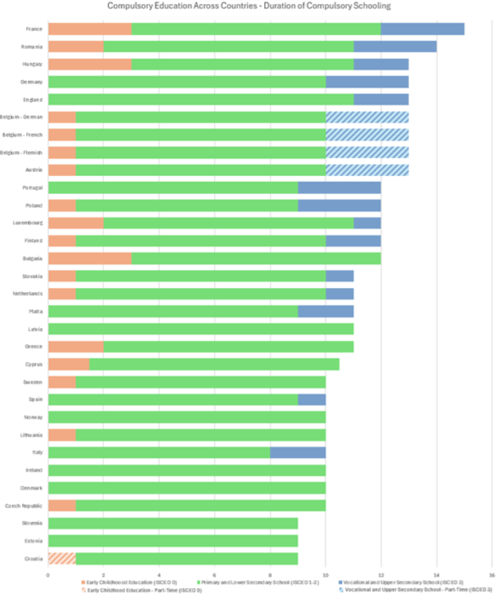
Compulsory education begins in pre-school in nineteen countries, with most setting a duration of 1 year of compulsory pre-school education. In Greece, Luxembourg, and Romania, the duration of compulsory pre-school education is 2 years, whereas Bulgaria, France, and Hungary require 3 years. At the opposite end of the spectrum, slightly more than one-third of the countries allow compulsory education to end with the completion of secondary education. Thus, just under two-thirds – eighteen countries – have implemented compulsory education that extends into vocational and upper secondary education. Half of these countries have set the duration of compulsory education in vocational and upper secondary schools at 3 years. Five countries prioritise 2 years, while four countries require 1 year of compulsory education at this level.
Source: Eurydice 2025. Chart constructed by Simon Nørgaard Iversen.
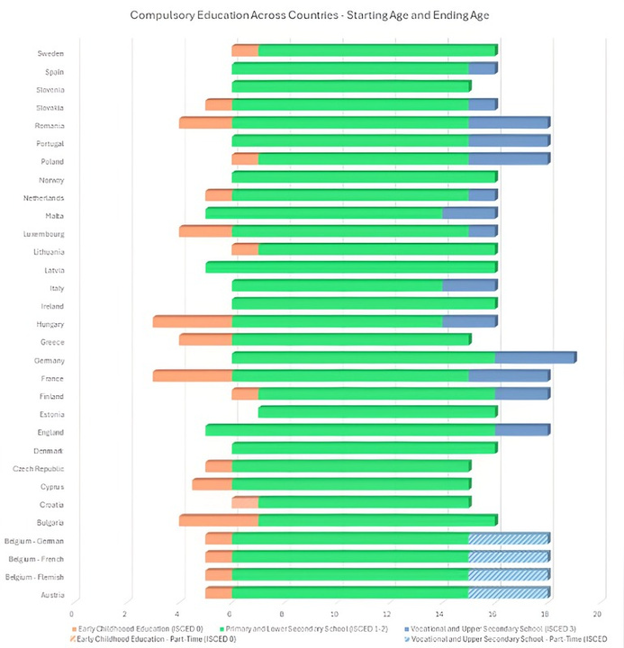
On average, compulsory education starts in the year when the child turns 5 years old, with only a few countries beginning compulsory education earlier: Cyprus at 4.5 years; Bulgaria, Greece, Luxembourg, and Romania at 4 years; and Hungary and France in the year the child turns 3 years old.
The starting age for enrolment in primary school is, in most countries, the year the child turns 6 years old. Only Bulgaria, Croatia, Estonia, Finland, Lithuania, Poland, and Sweden begin later, with enrolment in primary school in these countries occurring in the year the child turns 7. However, in most of these countries, compulsory education begins while the child is still in pre-school at age 6. In Bulgaria, compulsory education starts with 3 years of pre-school and thus begins in the year the child turns 4 years old. Estonia is the only country in which compulsory education begins in the year the child turns 7.
Compulsory education ends at age 16 in fifteen countries. The school-leaving age for compulsory education is on average 16.58 years, with Germany recording the highest at 19 years. Compulsory education ends at 18 years in Austria, all communities of Belgium, England, Finland, France, Romania, Poland, and Portugal, while in five countries – Croatia, Cyprus, the Czech Republic, Greece, and Slovenia – it ends at age 15.
3.1.2 Public Schooling and Tuition Fees
All European countries in question provide primary and lower secondary education free of charge (see Table 1). Almost all countries, with the exception of Slovenia, provide upper secondary education free of charge, while slightly more than half of all countries do so for education at ISCED level 4 or above. Thirteen countries either fully or partially charge for education at level 4 or above.
There are many different types of institutionalisation of Early Childhood Education and Care (ECEC) in relation to tuition fees. According to Eurydice, ECEC can be free of charge with or without a place guarantee, or it can be subsidised with a place guarantee, or provided as paid provision without a place guarantee. Only one country, Latvia, guarantees ECEC free of charge throughout all years of pre-school.
Table 1: Tuition Fees
NOTE: Information on ECEC fees in England is not included on Eurydice and is rendered NA (Not Available). Source: Eurydice 2024. Table constructed by STRIDE consortium members.
| Country | ECEC (ISCED 0) | ISCED 1 | ISCED 2 | ISCED 3 | ISCED 4+ | ||
|---|---|---|---|---|---|---|---|
| Age under 2 | Age 3 | Last ECEC year | Primary | Lower Sec. | Upper Sec. | Higher Ed. | |
| Austria | € ! | € ! | ✓ | ✓ | ✓ | ✓ | € |
| Belgium – Flemish | € ! | ✓ | ✓ | ✓ | ✓ | ✓ | € |
| Belgium – French | € ! | ✓ | ✓ | ✓ | ✓ | ✓ | € |
| Belgium – German | € ! | ✓ | ✓ | ✓ | ✓ | ✓ | € |
| Bulgaria | ✓ ! | ✓ ! | ✓ | ✓ | ✓ | ✓ | ✓ |
| Croatia | € ! | € ! | ✓ | ✓ | ✓ | ✓ | € |
| Cyprus | € ! | € ! | ✓ | ✓ | ✓ | ✓ | ✓ |
| Czech Republic | € ! | ~ | ✓ | ✓ | ✓ | ✓ | ✓ |
| Denmark | ~ | ~ | ~ | ✓ | ✓ | ✓ | ✓ |
| England | NA | NA | NA | ✓ | ✓ | ✓ | € |
| Estonia | ~ | ~ | ~ | ✓ | ✓ | ✓ | ✓ |
| Finland | ~ | ~ | ✓ | ✓ | ✓ | ✓ | ✓ |
| France | € ! | ✓ | ✓ | ✓ | ✓ | ✓ | ✓ |
| Germany | ~ | ~ | ~ | ✓ | ✓ | ✓ | ✓ |
| Greece | € ! | € ! | ✓ | ✓ | ✓ | ✓ | ✓ |
| Hungary | € ! | ✓ | ✓ | ✓ | ✓ | ✓ | ✓ |
| Ireland | € ! | ✓ ! | ✓ ! | ✓ | ✓ | ✓ | € |
| Italy | € ! | ✓ ! | ✓ ! | ✓ | ✓ | ✓ | € |
| Latvia | ✓ | ✓ | ✓ | ✓ | ✓ | ✓ | ✓ |
| Lithuania | ✓ ! | ✓ ! | ✓ | ✓ | ✓ | ✓ | € |
| Luxembourg | ✓ ! | ✓ | ✓ | ✓ | ✓ | ✓ | € |
| Malta | € ! | ✓ ! | ✓ ! | ✓ | ✓ | ✓ | € |
| Netherlands | € ! | € ! | ✓ | ✓ | ✓ | ✓ | € |
| Norway | ~ | ~ | ~ | ✓ | ✓ | ✓ | ✓ |
| Poland | € ! | ✓ | ✓ | ✓ | ✓ | ✓ | ✓ |
| Portugal | ✓ ! | ✓ | ✓ | ✓ | ✓ | ✓ | ✓ |
| Romania | ✓ ! | ✓ ! | ✓ | ✓ | ✓ | ✓ | ✓ |
| Slovakia | € ! | € ! | ✓ | ✓ | ✓ | ✓ | ✓ |
| Slovenia | ~ | ~ | ~ | ✓ | ✓ | € | ✓ |
| Spain | € ! | ✓ | ✓ | ✓ | ✓ | ✓ | € |
| Sweden | ~ | ✓ | ✓ | ✓ | ✓ | ✓ | ✓ |
Table Legend:
✓ = Free of Charge – Place Guaranteed
~ = Subsidised – Place Guaranteed
✓ ! = Free of Charge – No Place Guarantee
€ ! = Paid Provision – No Place Guarantee
€ = Charged or Partial Fees
Bulgaria, Lithuania, Luxembourg, Portugal, and Romania provide pre-school free of charge under the age of 2 but do not guarantee a place. This continues at age 3 in Bulgaria, Lithuania, and Romania, while Luxembourg and Portugal offer a guaranteed free place at age 3. Seven countries offer subsidised enrolment with a place guarantee, and five of these – Denmark, Estonia, Germany, Norway, and Slovenia – do so for all years of enrolment in pre-school. Finland maintains this until the final year of ECEC, at which point it offers a place guarantee free of charge, while Sweden implements this policy from age 3. In twenty-five countries, ECEC provision requires parents to pay fees, and there is no place guarantee under the age of 2. Austria, Croatia, Cyprus, Greece, the Netherlands, and Slovakia maintain this at age 3, after which they offer pre-school free of charge and with a place guarantee in the final year of ECEC. Ireland, Italy, and Malta all offer enrolment free of charge but without a place guarantee from the age of 3 onwards, while the Czech Republic provides a subsidised place guarantee at age 3 and then offers free enrolment with a place guarantee in the final year of pre-school. All three communities in Belgium, France, Hungary, Poland, and Spain offer a guaranteed free place from the age of 3 onwards.
In summary, most countries offer free enrolment from age 3, although not all countries guarantee a place. Almost all countries provide the final year of ECEC free of charge and with a guaranteed place. Thus, tuition fees for pre-school enrolment are in most cases discontinued at various points during pre-school as enrolment becomes free of charge, which could suggest that the gradual phasing out of tuition fees across pre-school years reflects a common European strategy of maximising enrolment at crucial moments in early children’s early education.
3.2 Overview of Reforms
3.2.1 Total Number of Reforms
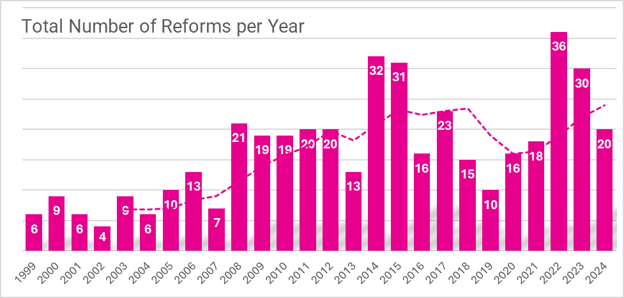
A total of 431 reforms has been identified in this survey. An analysis of the number of reforms identified per year reveals a steady increase in reform implementation across European countries. The period between 1999 and 2007 appears relatively stable, with a total of 6–13 reforms implemented per year. From 2008 onwards, there is an upward trend in the number of identified reforms. Between 2008 and 2012, between 19 and 21 reforms were identified annually across the European countries. In 2013, this number fell to 13 reforms, only to increase again to 32 and 31 reforms in the following two years. From 2016 to 2021, the number of new reforms remains relatively stable, fluctuating between 10 and 23 reforms per year. In 2022 and 2023, the number of reforms again increases before stabilising at around 20 identified reforms in 2024.
When reform implementation is described in five-year averages, the upward tendency becomes more apparent. An average of 6.8 reforms were implemented between 1999 and 2003, a figure that almost doubled to 11.8 between 2004 and 2008. A further significant increase occurred between 2009 and 2013, with 18.2 reforms implemented annually, rising again to 23.4 per year between 2014 and 2018. Between 2019 and 2023, a slight increase resulted in an average of 26 new reforms per year.
Over time, more reforms have been identified, although no firm conclusions can be drawn solely on this basis. While this may reflect a general tendency among European countries to develop and implement more reforms, the trend may also reflect differences in reform registration practices, suggesting that countries may be becoming more consistent in how they register reforms.
Chart constructed by STRIDE consortium members, retrieved 2024-2025.
3.2.2 Number of Reforms per Country
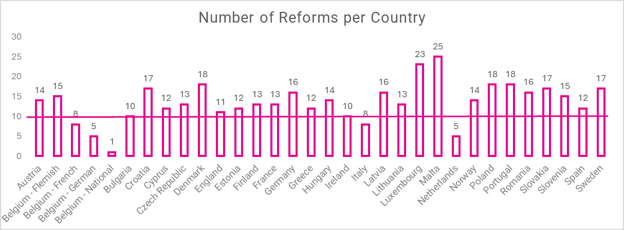
European countries have implemented an average of 13.47 reforms in total between 1999 and 2024. Most countries are close to this average, although a few – particularly Luxembourg and Malta – have implemented significantly more than average, while others, such as the Netherlands and Italy, have implemented significantly fewer. Within Belgium, the Flemish Community has implemented more reforms than the European average, whereas both the French and German Communities have implemented significantly fewer. Only one reform in Belgium has been identified as applying across all three communities, making it the only nationwide reform. If Belgium is considered as a single unit, however, it has implemented a total of 29 reforms, ranking it above both Luxembourg and Malta and raising the European average to 14.86 reforms.
Overall, this dataset suggests a broad and consistent concern among European countries for developing and implementing educational reforms aimed at addressing inequality, equity, and inclusion, with only a few outliers deviating significantly above or below the European average. However, differing registration practices across countries may explain some of the variation in identified reforms. It cannot be guaranteed that all countries follow equally streamlined processes for registering national reforms in international databases.
Chart constructed by STRIDE consortium members, retrieved 2024-2025.
3.2.3 Total Number of Reforms at Different ISCED Levels
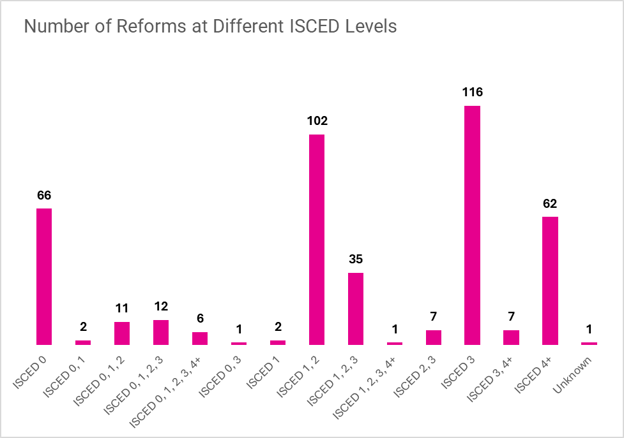
With regard to targeted ISCED levels, almost all reforms are directed exclusively at specific levels: ISCED 0 = 66 reforms; ISCED 1–2 = 102; ISCED 3 = 116; and ISCED 4 = 62. This indicates that European countries generally target reform efforts at distinct parts of the education sector, corresponding to the tiers defined by the International Standard Classification of Education (ISCED). While relatively few reforms target multiple ISCED levels, a total of 84 reforms are designed to affect more than one level. Notably, reforms targeted at ISCED levels 1–3 are substantially higher than other cross-ISCED reform constellations, suggesting that European countries have been particularly focused on the period from primary through lower secondary education (ISCED 1–2) to upper secondary education (ISCED 3).
Chart constructed by STRIDE consortium members, retrieved 2024-2025.
3.2.4 Types of Reforms
A total of five different types of reforms has been identified; a sixth category (unspecified) consists of reforms that have not been adequately described in the databases, making it difficult to clearly categorise them using either an a priori or a posteriori framework.
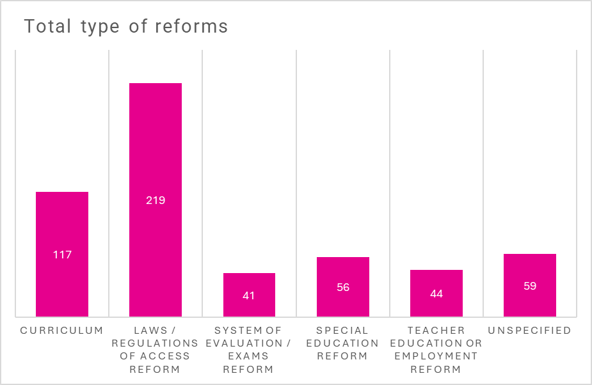
A total of 117 reforms are focused on curriculum changes, while 219 reforms aim at implementing general changes to the educational system or increasing access. 41 reforms target evaluation systems, including final examination regimes or admission procedures based on prior assessment. 56 reforms are directed toward special education, 44 focus on teacher education or employment, and 59 reforms are unspecified. The prevalence of general access reforms (219) suggests that countries prioritise structural access over other levers to increase participation, equity and inclusion in education.
Chart constructed by STRIDE consortium members, retrieved 2024-2025.
The total of 538 reform types in Chart 6 exceeds the 431 individual reforms, meaning that some reforms can be classified under more than one category. This suggests that some countries adopt reform strategies with broad or multi-faceted objectives, requiring multiple mechanisms to achieve reform goals. Alternatively, this could indicate that some countries employ a wide-ranging approach to achieve narrowly defined reform aims. Furthermore, the multi-faceted reforms indicate strategic attempts to address multiple barriers to inclusion simultaneously.
Chart constructed by STRIDE consortium members, retrieved 2024-2025.
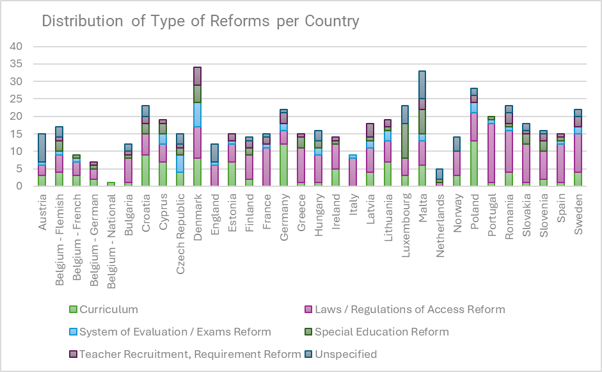
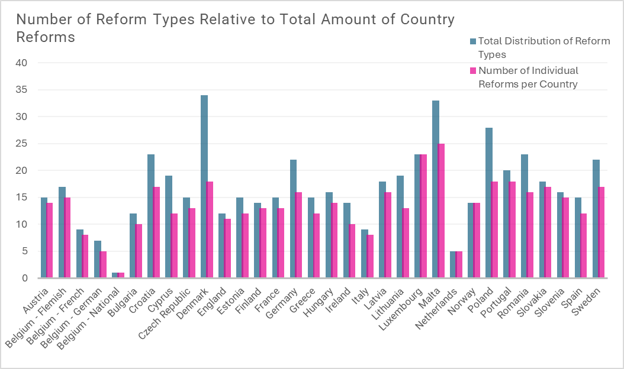
Not all countries adopt this strategy equally. Although many countries have reforms that fit more than one category, most reforms can be classified with a single type. However, a few countries exhibit a notable diversification of reform types relative to the total number of reforms. In particular, Denmark has implemented 18 individual reforms, which together span multiple categories, indicating a broad scope either in aims or measures. To a lesser but still significant extent, Croatia, Germany, Lithuania, Malta, Poland, Romania, and Sweden similarly demonstrate high levels of reform diversification. In contrast, reforms in the Netherlands and Norway have been categorised under only one reform type at a time.
3.2.5 Evaluations
Of the 431 identified reforms, only 129 have been clearly identified as having undergone evaluation. Of these, 20 evaluations highlight contradictory results, either because individual or multiple evaluations have reported differing outcomes, or because separate evaluations have reached contrasting conclusions regarding different aspects of a reform. Thirty-one evaluations clearly identify persistent issues in relation to a reform’s stated aim(s), indicating that these reforms have been largely unsuccessful. Thirty-three evaluations do not explicitly indicate whether the reform has met its aims or not. Forty-five evaluations draw positive conclusions, citing success in addressing inequality, equity, and inclusion in education. While these evaluations may not have covered all aspects of the reform, they emphasise positive effects in the parts they examined.
Chart constructed by STRIDE consortium members, retrieved 2024-2025.
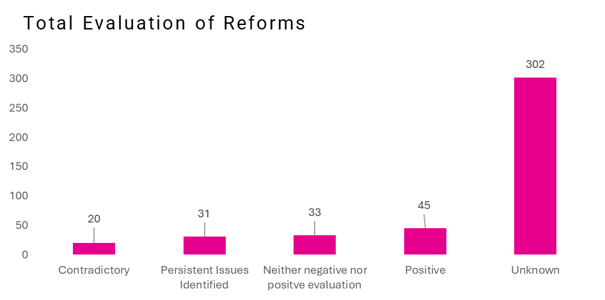
It has not been possible to identify evaluation results for a total of 302 reforms, which have therefore been categorised as “unknown” in terms of evaluation status. There are several possible explanations: some reforms may not have been evaluated at all or may have been too recent for evaluation. Some may have been evaluated, but their results were not identified in the available databases. In other cases, internal evaluations may not be publicly accessible, or evaluations may have formed part of smaller research projects not included in the datasets. Nevertheless, this relatively large group of reforms could suggest a potential gap in monitoring and accountability that might limit understanding of reform effectiveness, which could highlight the need for systematic monitoring that could be linked to broader EU policy recommendations.
3.3 Summary
Across Europe, compulsory education generally spans 9–15 years, starting between ages 3 and 7 and often extending into vocational or upper secondary education. Most countries provide free primary and lower secondary education, and a growing number offer free pre-school with a guaranteed place, reflecting a common policy emphasis on early access and equity. Private schooling exists at all levels, though participation rates vary, indicating potential socio-economic stratification. Governance structures differ, with some countries centralising curriculum and administration while others employ decentralised or hybrid systems, suggesting different approaches and traditions for balancing national standards and local autonomy. Governance structures in individual countries are not static but change over time. Concrete examples of this are e.g. reforms that aim to decentralise education practices by strengthening teacher autonomy. Other examples are reforms that seek to centralise education practices through the adoption of universal policies such as pertain e.g. to national examinations. Educational reform activity has increased over time, with a focus on access, curriculum changes, and inclusion, often targeting primary to upper secondary levels.