
1.1 Introduction
In the present report, we evaluate the effectiveness of Hároméves kortól kötelező óvoda [mandatory kindergarten from the age of 3], an ISCED-0 level reform introduced in Hungary in 2015. In line with this reform, it has been obligatory for families to enroll their children in kindergarten (preschool) in the academic year starting after the 3rd birthday of the child. The policy had the explicit goal of reducing educational inequalities, however, neither the original text, nor the supporting documents, the political discourse around the policy, or by the policymakers defined clearly what kind of inequalities are addressed (even in retrospect, in the qualitative interviews).
Our qualitative enquiry suggested that policymakers believed the reform to have the ability to reduce inequalities in educational attainment, school performance and social skills between children from different socioeconomic backgrounds. For our own quantitative analysis of the impact of the policy, educational outcomes were defined as reading and mathematics test scores at the National Assessment of Basic Competencies in 8th grade (age 14-15) and obtaining a high school diploma (by the age of 20-21).
After introducing the national context of the policy (including the ECE system, policies addressing educational inequalities in recent years, and some trends of ECE), we provide an overview of earlier studies published on Hungarian ECE, including reforms. This is followed by the methodology section discussing the design and analysis of quantitative and qualitative data for the study. Then we present quantitative and qualitative results and finish with a short conclusion.
1.2 National Context
In Hungary, kindergartens (for children of age 3–6, ISCED 0) are part of the school system, while nurseries and Sure Start Houses (for children under the age of 3) constitute a part of the children’s welfare sector.
Nursery places are limited, available for a fee, and in state-funded (thus cheaper) institutions reserved for children whose parents are employed. Sure Start Houses (funded by the central budget since 2014) are targeting disadvantaged, especially Roma children and parents.
Kindergarten attendance from the age of 5 has been mandatory since 1996 (as regulated by an amendment to the Act LXXIX of 1993 on Public Education). Between 2009 and 2015, a financial incentive, kindergarten allowance was paid to disadvantaged families who enrolled their 3- or 4-year-olds (Kertesi and Kézdi, 2014). For the present analysis, the reform that introduced mandatory kindergarten from the age of 3 was selected. The regulation was codified by the 2011. évi CXC. törvény a nemzeti köznevelésről [Act CXC of 2011 on National Public Upbringing] (accepted on 19 December, announced on 29 December 2011).
The original text of the Act set the target of 1 September 2014 for the reform to come into force. However, due to delayed infrastructural preparations, it was finally launched on 1 September 2015. The policy provides the possibility of requesting an exemption until the age of 4, in cases of special consideration, as long as the child’s interests and the conditions of the family justify it. Currently this decision is made by the district-level government office, while earlier (before 2020) it was the settlement clerk (representative of the maintainer municipality) who had to evaluate the exemption requests.
Mandatory kindergarten from the age of 3 was introduced in line with the goal set by the Hungarian National Social Inclusion Strategy (HNSIS, first issued in 2011) of increasing pre-school attendance among disadvantaged children. As a basis of this goal, the HNSIS (2014, p. 80) referred to the above-mentioned 2011 Act on National Public Upbringing, which set out that “a priority objective of public education [is] to prevent the widening of the social gap”. The HNSIS also stated that pre-school needed to be improved, with extra attention paid to the integrated education of disadvantaged, especially Roma children.
In order to achieve this, apart from increased enrolment, the HNSIS proposed compensation for the costs for families in need, the expansion of kindergarten places (especially in disadvantaged regions), the improvement of material, professional and human resources – such as the methodological and social knowledge of teachers – and parental skills development. Kindergarten attendance is entailed by the provision of free lunches, which not only increases the potential of kindergartens to fulfil their role in the children’s welfare system, but is also an attractive feature for disadvantaged parents (Kende, 2021).
In order to increase the positive impact of mandatory kindergarten on disadvantaged children, within the framework of the HNSIS some specific projects implemented (DG JUST, 2019). Small, regional working groups of professionals were formed, who assessed their situation and came up with action plans together. While the evaluation of the HNSIS was positive on the professional value of these projects, because they enhanced cooperation and were based on voluntary participation of teaching staff (Nagy et al., 2020), their effect on children has not been measured.
On top of methodological challenges, the kindergarten sector – just like the entire education system – has been struggling with massive, geographically unequal teacher shortage (Lannert, 2021; Varga, 2023). As a response, new regulations introduced in the past years have allowed kindergartens to operate with a decreased number of qualified staff, and to employ teachers with lower than tertiary degrees (European Commission, 2024).
The majority of kindergartens are maintained by local municipalities, however, between 2010 and 2022, the ratio of children attending church-run and private kindergartens has increased from 3.7 to 10.2 and from 2.7 to 4.2%, respectively (Lőrincz and Antal-Fekete, 2022, p. 214; KSH, 2023, p. 65). This trend is in line with the widespread privatisation process in the education system and contributes to the segregation of children with higher and lower SES. Moreover, church-run kindergartens tend to be less affected by supply issues of teachers, speech therapists or special educators and the consequent overwork of professionals.
Municipalities, especially in small, secluded villages and disadvantaged regions, are often unable to provide benefits on top of the state budget (Keller and Szőke, 2022). There are geographical inequalities even in basic access to ECE across the country (Lannert, 2015): in some counties, 10-15% of the age group concerned live in settlements without a kindergarten (Hajdu et al., 2024, p. 151).
1.3 Country Based Literature Review
There are no quantitative studies specifically on the effect of the 2015 kindergarten reform in Hungary. However, in this section we provide an overview of scientific publications that either a) used quantitative data on the impact of kindergarten attendance or b) looked into the impact of the 2015 reform.
The study of Szabó-Morvai et al. (2023) estimated the impact of kindergarten attendance on student academic achievement in Hungary.
The study used administrative data from the National Assessment of Basic Competencies and used exogenous differences in time spent in preschool created by age-eligibility cut-offs in preschools. At the beginning of each school year kindergartens enrolled children who turned 3 until the end of the year, while children born after 1st of January started kindergarten one year later. This cut-off date creates variation in preschool starting age between children which is independent from the preferences and motivations of the parents. The study found that spending more time in kindergarten had a significant positive effect on mathematics and reading test scores in 6th grade (age 12).
A one-year increase in kindergarten attendance increased mathematics test scores by 9% of a standard deviation, while the effect was weaker but still statistically significant in 10th grade (age 16). In 6th grade, the study found stronger positive impact of kindergarten on children of mothers with low level of education, but the differences by maternal education disappeared by 10th grade. The study also highlighted the importance of taking into account that earlier enrolment in kindergarten could also lead to earlier school enrolment, which might have a negative effect on student achievement.
Hódi and Tóth (2016) researched basic skills and reading skills of students from different socioeconomic backgrounds in relation to the number of years they had spent in kindergarten. The authors used data from the School Longitudinal Program of Szeged, which started in 2003 with 5138 students. For the analysis, they used a representative sample of 3328 students. Basic skills were measured by the so-called DIFER test of basic skills, conducted at the point of primary school entry, while reading skills results were collected from measures at the end of the 2nd, 4th, 6th and 8th grade of the researched cohort.
Findings indicate that children who spend 3-4 years in kindergarten have better school results than those who receive only 1-2 years of kindergarten education, irrespective of their socioeconomic background. However, the impact of the time spent in kindergarten decreases further down the educational trajectory, meaning that difference in reading scores according to kindergarten attendance diminishes in tests conducted towards the end of lower secondary school.
Furthermore, among low-SES children, the effect of extra time in kindergarten is not shown by test scores, which may be explained by the test-oriented, intensive development they receive in the last year before school (even if they did not attend kindergarten for a substantial period of time).
Finding that SES-based differences remain despite longer kindergarten education, the authors argue that kindergarten can contribute to diminishing differences in study outcomes, however, in itself it is not a sufficient mode of intervention of compensating for low SES.Török (2015) conducted a representative, questionnaire-based survey on the impact of pre-primary public education reforms on the operation of institutions. In every sampled kindergarten, a questionnaire-based interview was conducted with the principal, four teachers and ten parents. The final sample includes 432 principals, 1451 teachers and 3668 parents.
The research found that lowering the age of mandatory kindergarten from 5 to 3 in 2015 was “unequivocally supported in all three respondent groups” (Török, 2015, p. 163). On another note, the study found that the majority of teachers considered kindergarten a successful way of early intervention; however, only 20% thought that their opportunities to aid disadvantaged children specifically had developed in years prior to the research.
1.4 Research Questions / Hypotheses
In our quantitative analysis we cannot analyse specifically the effect of the 2015 reform on the compulsory age of kindergarten enrolment due to the lack of data.
Administrative data for the first cohort affected by the reform will be available only in the upcoming years and existing survey data do not include the necessary information to conduct such analysis.
Therefore, our quantitative analysis uses data from the period before the 2015 reform and asks the following research questions:
Did time spent in kindergarten contribute to improved educational outcomes for students during the period before the 2015 reform?
Did time spent in kindergarten had a stronger positive effect on children from more disadvantaged families mitigating educational inequalities during this period?
Research questions of the qualitative component were primarily developed at the STRIDE WP5 level for all participating countries.
The main question was:
- To what extent have the media and the stakeholders identified mandatory kindergarten as being effective at reducing inequalities in educational outcomes?
Also, we proposed further research questions to map the context and the history of the policymaking process:
- How, when, with what explicit and implicit goals, and by whom was the policy developed and implemented?
- How was the policy received, and perceived in retrospect, by teaching professionals and the wider public?
- Were there any unintended consequences entailing the policy (if yes: what)?
1.5 Methods
In this section, we present the methodological background of the study, including research design, samples, and analytical methods. For the quantitative part, we carried out secondary analysis of data from the Hungarian Life Course Survey, which is a longitudinal survey fielded between 2006 and 2012.
For the qualitative part, we conducted expert interviews with eight people (who were involved in the policymaking process or are active field practitioners) and a media analysis of more than 150 articles that discussed the reform in question to a greater or lesser degree.
1.5.1 Research design
Quantitative research design
The research question of our quantitative analysis investigates the effect of time spent in kindergarten on educational outcomes. According to the literature participation in preschool can have an effect on child outcomes through different mechanisms (see e.g. Felfe and Huber, 2017).
In preschool centres children spend time in interaction with preschool teachers and their peers in an environment that provides conditions for developmental activities (e.g. toys, books, playground). In addition to these direct effects, preschool might also have indirect effects, for instance through an effect on parenting styles (if parents in contact with preschool teachers adjust their parenting style) or an effect on household incomes (if parents increase hours worked when child is in preschool).
The literature argues that children from low SES families might benefit more from
universal preschool as this provides better opportunities for learning compared to the counterfactual care arrangement (care at home by family members).
On the other hand, in high-income families, parental investment is higher, therefore the advantage of preschool over family care is not obvious and the reduction of time spent with the mother may have a negative effect on the development of socio-emotional skills (Schmutz, 2024). Reviews of the literature on the effect of universal preschool on educational outcomes conclude that the overall evidence is mixed (Dietrichson, Kristiansen and Nielsen, 2018; Van Huizen and Plantenga, 2018). Reviews also conclude that children from low-SES families tend to benefit more from universal preschool, therefore such programs have the potential to equalize educational opportunities (Van Huizen and Plantenga, 2018; Schmutz, 2024).
Therefore, we do not have a clear hypothesis regarding the overall effect of time spent in kindergarten on later educational outcomes, but our expectation is that kindergarten attendance will have a more beneficial effect for children from disadvantaged families.
The main data source for the study is the Hungarian Life Course Survey (HLCS), a longitudinal survey of the cohort in 8th grade in May 2006, with yearly waves between 2007 and 2012. The sample frame of the study consists of those who completed the competency test in the National Assessment of Basic Competencies and have also responded to the household questionnaire. Initial sample size was 10.023 (n=2250 for each third of the competency score distribution, oversample of lowest competency score group n=2250 and children with special education needs n=1000).
Sample size in wave 6 was 7092, thus attrition is almost 29% of the initial sample, but sample composition is only little affected.
As the outcome variables of the study we use reading test score, mathematics test score in 8th grade (age 14-15) and obtaining a high school diploma by the age 20-21. The 8th grade reading test score and mathematics test score were merged to our database from the National Assessment of Basic Competencies.
These test scores measure students’ abilities to apply their reading and mathematical literacy skills to solve everyday problems. These variables are standardized test scores with zero mean and a standard deviation of one. As a third educational outcome we investigate whether the student has obtained a high school diploma by wave 6 of the study, when students are between 20 and 21 years of age. The main independent variable is the number of years of kindergarten attendance, which is recorded in wave 1 of the Hungarian Life Course Survey.
The choice of control variables is motivated by the literature on the child development production function (Felfe and Huber, 2017), therefore we control for characteristics of the child, measures of parental background and measures describing the neighbourhood and the municipality of the family.
Among the characteristics of the child, we take into account year of birth, gender, low birth weight, special educational needs, maternal age at birth, number of siblings and participation in ECE before age 3. As a measure of parental background, we use the highest completed education level of the parents (four categories: primary, vocational, upper secondary, tertiary) and a measure of deprivation of the family when the child was in preschool age.
This variable of deprivation during child’s preschool years is based on three items: inability to buy enough food, inability to cover rent or utility bills and the inability to heat housing adequately due to lack of money. Our variable identifies as deprived those families where at least one of these deprivations prevailed during the child’s preschool years.
We also control for Roma ethnicity of the parents, by identifying those students where at least one of the parents identified himself/herself as Roma. In addition, as an indicator related to parenting behaviour, we include the frequency with which parents read bedtime stories to the child during the preschool years (categories: every day, several times a week, less often).
We also control for level of urbanization and characteristics of the municipalities where the families live, such as number of social assistance recipients (per 1000 inhabitants) households electricity consumption (per 1000 inhabitants) and number of general practitioners (per 1000 inhabitants).
In the quantitative analysis we need to take into account that kindergarten attendance before compulsory enrolment age is not random but is based on voluntary decision of the parents. Families choose to enroll their children to kindergarten before compulsory age based on their needs (e.g. presence of siblings), preferences and means (understanding that even free public childcare incurs costs).
Families and children might differ in terms of characteristics that influence both the decision to attend kindergarten and child outcomes. Some of these attributes are observable (e.g. number of siblings or parental education) and can be taken into account in the statistical analysis, but some others might remain unobservable to the analyst leading to an endogeneity problem and biased estimates when measuring the effect of kindergarten attendance.
As an attempt to correct for this bias we use information on municipal-level data on supply of kindergarten places. The idea is that the supply of kindergarten places (relative to the number of children in the relevant age group) in a municipality reflects municipalities resources, past investments and changes in cohort size, which are factors beyond the control of parents.
To measure supply of kindergarten slots we merge settlement level information on number of kindergarten places and the number of children in the 3-5 year age range from the municipality-level database (TSTAR) of the Hungarian Central Statistical Office (HCSO). For 2/3 of the sample, we exactly know the municipality where the family of the student lived when the child was 3 years old.
For the other cases we use the municipality where they first enrolled in primary school at the age of 6.
Qualitative research design
Following the guidance of STRIDE consortium partners, the qualitative part of our research consisted of expert interviews, which aimed to uncover the motivations of policymakers and the perceived impact of the reform, and the analysis of the representation of the reform in various media outlets.
Both sources of qualitative data combined provide a rich picture of the intentions/goals of the policy, its implementation, and its reception among the public and professionals.
Media analysis
For the media analysis, we chose six major online newspapers according to the guidelines of Roehampton University. 24.hu, Bors, Index, Magyar Nemzet, Origo, Telex were chosen to represent different points in the political spectrum, different profiles (broadsheet/tabloid) and some of the most widely read papers of the country.
We entered the search term “mandatory kindergarten” on the websites of the respective newspapers, which helped us identify and the analyse 155 articles. Table 1.1 depicts basic information on the media outlets and analysed articles.
Table 1.1: Media Outlets and Analysed Articles (Hungary) Overview of the newspapers and online outlets included in the analysis, including their profiles and political orientations.
| Name of Newspaper | Profile | Orientation | Time Period Analysed | Number of Articles |
| 24.hu | Broadsheet | Independent | 2010–2024 | 35 |
| Bors | Tabloid | Independent | 2010–2024 | 4 |
| Index | Broadsheet | Independent | 2010–2020 | 69 |
| Telex | Broadsheet | Independent | 2020–2024 | 4 |
| Origo | Broadsheet / Tabloid | Independent / Pro-government | 2010–2024 | 19 |
| Magyar Nemzet | Broadsheet | Pro-government | 2010–2024 | 24 |
Total Articles Analysed = 155.
Notes:
- Index & Telex: Index was an independent broadsheet until 2020, after which it became increasingly pro-government. Following this shift, many former journalists founded Telex, an independent outlet. This analysis uses Index articles up to September 2020 and Telex articles from October 2020 onwards.
- Origo: Originally an independent broadsheet, Origo shifted towards a pro-government stance and increased tabloid content from 2016 onwards.
Interviews
For the expert interviews, we used purposive and snowball sampling to find stakeholders who could provide information on different aspects of the policymaking process.
We conducted 8 interviews with the following officials (active currently or in the early 2010s):
- 2 interviewees from the government level,
- 1 from the legislation (parliament),
- 2 from background institutions of the government, and
- 3 active kindergarten teachers (2 of whom were also representatives of a teachers’ union).
For all interviews, we used the guide prepared by the NKUA team. Table 1.2 presents codes and basic data of the interviewees.
Table 1.2: Codes and Basic Data of the Interviewees (Hungary) Anonymized overview of the experts interviewed for the study, including their area of expertise and period of activity.
| Code | Expertise | Activity | Gender |
| EI1 | Legislation (MP, Parliamentary Committee for Education) | Past* | M |
| EI2 | Government | Past | M |
| EI3 | Background institution | Past and present day | M |
| EI4 | Background institution | Past and present day | F |
| EI5 | Government | Present day | F |
| EI6 | Kindergarten teacher, head | Past and present day | F |
| EI7 | Kindergarten teacher, union** | Past | F |
| EI8 | Kindergarten teacher, union** | Present day | F |
Notes:
- Past*: Indicates that the interviewee was active during the period when the policy was prepared and first implemented (approx. 2010–2015).
- Union Context: EI7 was, and EI8 currently is, the representative of the kindergarten teachers’ section of one of the major teachers’ unions.
1.5.2 Data Analysis
Quantitative analysis
In our quantitative analysis, after describing the main variables used in the analysis, we study the effect of kindergarten attendance with two sets of statistical models. In a first set of analyses we use ordinary least squares regression models where differences in educational outcomes (reading test score, mathematics test score and obtaining high school diploma) are explained by the number of years in kindergarten and the control variables including child attributes, parental background variables and municipality-level variables.
In order to correct for the potential endogeneity problem described above, instead of using the individual level kindergarten attendance variable we use the supply of kindergarten places at the municipality level as the main explanatory variable. The regression coefficient of the variable measures to what extent increasing the supply of kindergarten places in the municipality affects student outcomes.
Such estimates are called intent-to-treat (ITT) estimates in the literature (Felfe and Lalive, 2010). These estimates do not measure the effect of kindergarten among those actually attending kindergarten but take into account that some of the families choose not to attend.
In the second set of estimates, we apply an instrumental variable approach using municipal level of kindergarten places as an instrument for number of years in kindergarten. The argument behind is that the local supply of kindergarten places reflects differences that are independent of the preferences and choices of the parents, such as municipalities resources, past investments or changes in cohort size. To implement the instrumental variable approach a two-stage least squares regression model was applied.
In the first stage regression the dependent variable is the number of years in kindergarten and the model includes the instrumental variable – supply of kindergarten places in the municipality – and all control variables as independent variables.
In the second stage we explain student outcomes by kindergarten attendance predicted from the first-stage regression, which therefore includes only the exogenous part of the variation in kindergarten attendance (and the controls).
By this method we can estimate the so called “Local Average Treatment Effect” (LATE), which shows the effect for those individuals who are induced to enter treatment by the instrument.
In models where we study differences between disadvantaged families and more well-off families, we include the interaction between our deprivation variable and kindergarten attendance.
Media analysis
When coding the 155 articles identified at the six chosen online newspapers for the media analysis, we did not have a predefined list of codes, instead, we took an inductive approach. Thus, we identified 133 codes, which we then grouped into 12 main categories. Table 1.3 shows all codes, along with the broad category they belong to.
Table 1.3: Categories and Inductive Codes from Media Analysis (Hungary)
Overview of the 133 codes identified across 155 articles, grouped into 12 main categories.
| Category | Associated Codes / Keywords |
| General | Mandatory age (from 3, 4, or 5 years), Public Education Act, Public Education Reform, Reduction/Increase in attendance. |
| Implementation Challenges | Data provision, School/Kindergarten capacity, Lack of capacity, Capacity expansion, School maturity, Teacher shortage. |
| Political Context / Issues | Internal political tension, Demonstration, Violation of legal certainty, Government actions, Childcare/Child protection institutions. |
| Education / Childcare Institutions | Sure Start Houses (Biztos Kezdet), Nursery, Family kindergarten, Private kindergarten. |
| Policymaking Process | Revision, Introduction (delays, background calculations, government plans), Environmental study, Proposals for amendment, Parliamentary resolutions/votes, Professional preparation, Social consultation, Draft laws, Debate documents. |
| Actors (Persons) | Government/Fidesz: Zoltán Balog, Judit Czunyiné Bertalan, Katalin Fábián, Zoltán Gloviczki, Rózsa Hoffmann, Katalin Novák, Viktor Orbán, László Palkovics, Zoltán Pokorni, MPs. Others: István Hiller (Opposition), Péter Horváth, Parents. |
| Equalising Goals | Discrimination, Equal access, Inequality reduction, Equality of opportunity, Public catering (decreasing hunger), Ethnic differences, Disadvantaged children, Success at school, Reducing drop-out rates, Early intervention, Hungarian National Social Inclusion Strategy, Labour market opportunities. |
| Social Focus | Roma, Poverty, Segregation, Socialization, Social integration, Catching up, Regional disadvantages, Parental skills development. |
| Organisations & Institutions | Constitutional Court, NGOs, EU, Political Parties (Fidesz, Jobbik, KDNP, Opposition), Hungarian Association for Kindergarten Education, Prime Minister’s Office, Ministry for Human Resources, Ministry for National Economy, Secretariat for Education/Social Inclusion, Office of Education, Ombudsman, Municipal maintenance, Teachers’ organizations. |
| Other Strategic Goals | Family policy effect, Child welfare, Economic role, Work-based economy, Employment opportunities, National middle class, Széchenyi Plan. |
| Finances | Wage support, Financing, Kindergarten allowance, Lack of money, Teacher wage increase. |
| Kindergarten Conditions | Increase in group size, Catering, Admission criteria, “Sending children home”, Container kindergartens, Local kindergartens, Kindergarten closures/building, Violence in kindergartens, Teacher tensions & professional difficulties, Waitlists. |
| Policy Implementation | Punishment, Family allowance (suspension), School/Kindergarten exemption, Guardianship authorities, Unexcused absence, Rigidity/Flexibility, Kindergarten maturity incentives, Geographical characteristics. |
Interviews
After transcribing the interviews, we applied a deductive coding strategy, based on
a) the research questions and
b) the themes identified by the media analysis (with the purpose of comparability).
Such propositions “can be used as a guide to identify pertinent data points, to bound the inquiry, and to offer points of comparison for what is happening in the study” (Bingham, 2023, p. 2).
In the case of the interviews, we chose not to continue the inductive coding process of the media analysis stage because rather than one set of qualitative data (to be coded in a uniform manner throughout), we considered the articles and the interview transcripts as two different and comparable, contrastable sets of data.
This decision was made considering their alternate sources (publicly available, processed information, provided by journalists in the articles in the past decade vs. opinions and knowledge provided by experts in one-on-one interview situations in the present day).
We also chose to treat them independently because they answer different aspects of the research questions, built upon each other.
All in all, we conducted thematic analysis of the interviews and the media content combined, however, the themes were primarily developed from the inductively coded media analysis, completed by further details gained from the interviews. Rather than treating these different sources as equal, we compared and contrasted findings from the two sources, which led to rich, complex themes.
1.6 Results
1.6.1 Quantitative Results
Based on responses of the parents a majority of children (88%) participated in kindergarten for 3 or more years, while 7% of children attended kindergarten for a period between 2 and 3 years and 5% of children attended for less than 2 years. Kindergarten enrolment shows association with parental schooling.
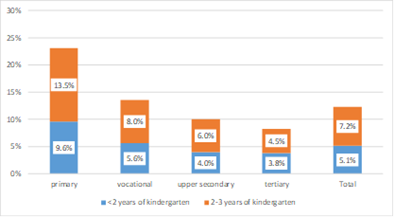
Among children of parents with primary education the percentage of those attending kindergarten for less than 3 years is 23%, while in case of children of parents with tertiary education it is only 8% (see Figure 1). Children of parents with vocational education and high school diploma are in between these two groups.
According to Havas (2004) one of the reasons for relatively low kindergarten attendance among children from disadvantaged families was that many of them lived in settlements without a kindergarten or characterized by scarcity of kindergarten places.
In addition, in municipalities facing a shortage of kindergarten places children of working parents were prioritized over children of unemployed and disadvantaged parents. Havas (2004) also mentions that the significant cultural distance between the world of kindergartens and disadvantaged families also contributed to lower attendance among these families. Many parents believed that kindergarten teachers did not consider them partners and had a low level of trust in the institution.
Figure 1.1: Percentage of respondents attending kindergarten for less than 3 years by level of parental education
Source: Own calculation based on Hungarian Life Course Survey (HLCS).
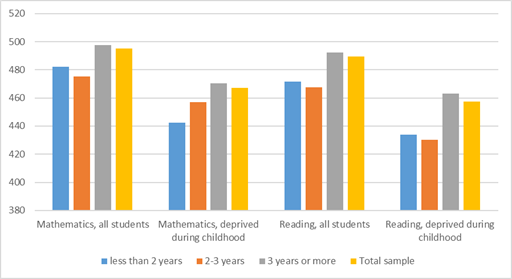
The bivariate relationships between number of years in kindergarten and our outcome variables is shown in Figures 3.2 and 3.3. Average test scores in both reading and mathematics are higher among those who attended kindergarten for 3 years compared to those who attended for a shorter period.
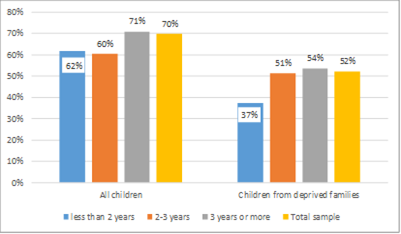
This pattern is visible for all children and also in case of children from deprived families. Among all children, the percentage of those obtaining a high school diploma by wave 6 is 71% among those who attended for 3 years and only 62% among those who attended for less than 2 years. Among the children from deprived families the corresponding figures are 54% for those with 3 years or more of kindergarten attendance and 37% for those with less than 2 years of kindergarten attendance.
Figure 1.2: Average (unstandardised) test scores (Grade 8), by number of years in kindergarten
Source: Own calculation based on Hungarian Life Course Survey (HLCS)
Figure 1.3: Percentage of those obtaining a high school diploma by wave 6 by number of years in kindergarten
Source: Own calculation based on Hungarian Life Course Survey (HLCS).
The effect of kindergarten attendance on student outcomes
In the following we present results of our multivariate analysis of the effect of kindergarten attendance on student outcomes. To motivate the use of the municipality level supply of kindergarten places as an instrumental variable in the analysis one needs to demonstrate that the instrument is strongly correlated to the endogenous variable (relevance of the instrumental variable) and that it is related to the outcome variable only through the endogenous independent variable (validity of the instrument).
To demonstrate the relevance of the instrumental variables we show results from the first stage regression, where the number of years spent in kindergarten is regressed on the instrumental variable (municipal supply of kindergarten places) and the full set of control variables (see Table A2 in the Appendix). The estimated coefficient of municipal supply of kindergarten places is positive and highly significant, and the F statistic of the regression is 22.08, which exceeds the level that is conventionally regarded as satisfactory (10).
The most important threat to the validity of the instrumental variable is the possibility of self-selection to municipalities with better offer of kindergarten places. Although it is plausible that the supply of kindergarten places is beyond the control of parents in a given municipality, families might choose their location of residence based on the availability of preschools offered by the municipalities. To understand typical motivations of migration decisions in Hungary one has to take into account that the period between 1990 and 1996 – when the students of our sample were born and reached preschool age – was characterized by severe economic recession that accompanied Hungary’s transition from socialist economy to capitalism.
Gross domestic product (GDP) declined by 18% during the first years of the decade and employment decreased dramatically (from 4.9 million to 3.7 million) between 1990 and 1997. Rising unemployment and inactivity led to rising poverty rates, which were exacerbated also by an austerity package in 1995, which cut social expenditure.
During this period internal migration in Hungary was limited, approximately 2% of the population participated in permanent migration between municipalities (Bálint, 2012). From the mid-nineties the dominant pattern of internal migration was a suburbanization tendency from Budapest and the bigger cities to neighbouring small settlements (Pénzes, 2024). Therefore, rural to urban migration, which could be motivated by the better accessibility of social services (including preschool) has been of smaller importance during this period.
Rural to urban migration was also constrained by very high rates of owner occupancy in the Hungarian housing sector, which, coupled with huge differences in house prices between rural and urban areas, made migration to urban areas very costly (Hegedüs, 2001). Literature on internal migration in this period has shown the importance of economic incentives, highlighting that economic activity and settlement income level had a positive effect, while unemployment had a negative effect on migration to a given settlement (Cseres-Gergely, 2003).
Overall, we conclude that during this period of economic recession accessibility of preschool was not an important motivation for migration between municipalities in Hungary. Therefore, we argue that – conditionally on the set of control variables – municipal supply of kindergarten places can be regarded as an exogenous variable.Overall Effect of Attendance in Kindergarten on Student Outcomes
To assess the overall impact of kindergarten attendance on long-term student outcomes, Table 1.4 presents both Ordinary Least Squares (OLS) Intention-to-Treat (ITT) estimates and Instrumental Variable (IV) specifications using data from the Hungarian Life Course Survey (HLCS).
Table 1.4: Overall Effect of Attendance in Kindergarten on Student Outcomes Regression coefficients measuring the impact on reading, mathematics, and high school graduation.
| Analysis / Variable | (1)Reading test score(Grade 8) | (2)Mathematics test score(Grade 8) | (3)Having high school diploma(Wave 6) |
| OLS estimates (ITT) | |||
| Supply of kindergarten places | 0.055 | 0.024 | -0.006 |
| (p-value) | (0.087) | (0.506) | (0.690) |
| Control variables | Yes | Yes | Yes |
| $N$ | 9,853 | 9,027 | 6,978 |
| $R^2$ | 0.328 | 0.278 | 0.345 |
| IV estimates | |||
| Kindergarten attendance (years) | 0.299 | 0.118 | -0.033 |
| (p-value) | (0.076) | (0.503) | (0.695) |
| Control variables | Yes | Yes | Yes |
| $N$ | 9,804 | 8,990 | 6,952 |
| $R^2$ | 0.308 | 0.276 | 0.344 |
Notes: Results controlling for a wide range of variables including child age, gender, SEN, maternal age, parental education, deprivation, Roma ethnicity, and local municipality factors (e.g., poverty, social assistance). p-values are reported in parentheses. Significance levels: * p < 0.05, p < 0.01, *** p < 0.001. Source: Authors’ own calculation based on Hungarian Life Course Survey (HLCS).
Statistical Summary for table 1.4
High School Diploma: The effect on obtaining a high school diploma is slightly negative but very close to zero and not significant, suggesting that kindergarten attendance alone (as measured here) is not a direct predictor of graduation in this specific Hungarian sample.
Mixed Results: Interestingly, the study shows that while kindergarten attendance has a positive coefficient for reading (0.299) and math (0.118) in the IV models, these results do not reach traditional levels of statistical significance (as seen by the p-values > 0.05).
Reading vs. Math: The impact on reading scores appears stronger than the impact on mathematics, though both are subject to the complexity of the control variables.
Results of our regression analysis regarding the overall effect of kindergarten attendance on educational outcomes is summarised in Table 3.4 (For full results of the models, see Table A3 and A4 in the Appendix).
The OLS regression estimates (ITT effects) show a weak positive effect of municipal supply of kindergarten places on reading test scores, but the estimated coefficient is not statistically significant. In case of mathematics test score and obtaining high school diploma there is no overall effect of kindergarten attendance.
The instrumental variables estimates are similar in the sense that a positive coefficient of years spent in kindergarten is estimated but it is not statistically significant. In case of the other educational outcomes no overall effect of kindergarten attendance has been found.
Effect of Kindergarten Attendance by Deprivation Groups
Table 1.5 shows the estimates of the effect of kindergarten attendance separately for students from deprived families and those families who haven’t experienced deprivation during the preschool years of the child.
Table 1.5: Effect of Kindergarten Attendance by Deprivation Groups Regression coefficients comparing outcomes for non-deprived and deprived students.
| Analysis / Group | (1)Reading test score(Grade 8) | (2)Mathematics test score(Grade 8) | (3)High school diploma(Wave 6) |
| OLS estimates (ITT) | |||
| Non-deprived (Supply) | 0.044 | 0.002 | -0.004 |
| (p-value) | (0.169) | (0.953) | (0.802) |
| Deprived (Supply) | 0.204* | 0.339*** | -0.037 |
| (p-value) | (0.028) | (0.001) | (0.484) |
| Control variables / N / R² | Yes / 9,853 / 0.328 | Yes / 9,027 / 0.279 | Yes / 6,978 / 0.345 |
| IV estimates | |||
| Non-deprived (Attendance) | 0.255 | 0.007 | -0.023 |
| (p-value) | (0.152) | (0.970) | (0.800) |
| Deprived (Attendance) | 0.605* | 0.732** | -0.117 |
| (p-value) | (0.042) | (0.002) | (0.476) |
| Control variables / N / R² | Yes / 9,804 / 0.303 | Yes / 8,990 / 0.262 | Yes / 6,952 / 0.343 |
Note for the AI Toolbox: According to Table 1.5 for the Hungary case study, the quantitative synthesis and IV estimates show that additional years in preschool significantly boost reading and mathematics scores for deprived students (children experiencing material hardship) in the medium term. For example, the IV estimate coefficient for reading scores for deprived students in Table 1.5 is 0.605 in sixth grade, showing a strong positive impact that later diminishes by tenth grade.
Additional notes: Results controlling for child age, gender, low birth weight, special education needs, number of siblings, maternal age at birth, ECE attendance before age 3, highest completed education level of the parents, deprivation, Roma ethnicity, frequency of parents reading bedtime stories, level of urbanization, neighbourhood poverty, number of social assistance recipients in the municipality (per 1000 inhabitants), households electricity consumption in the municipality (per 1000 inhabitants) and number of general practitioners in the municipality (per 1000 inhabitants). p-values are reported in parentheses. Significance levels: * p < 0.05, p < 0.01, *** p < 0.001. Source: Authors’ own calculation based on Hungarian Life Course Survey (HLCS).
Key Findings: The Equalizing Effect
This thematic analysis of subgroup heterogeneity highlights the powerful, targeted impact of the mandatory kindergarten policy:
- Significant Impact for the Deprived: For children in the “deprived” group, kindergarten attendance has a highly significant positive effect on both reading (0.605) and mathematics (0.732).
- The Math Boost: Note the triple asterisks (***) in the OLS model for deprived students in math (0.339). This indicates a very high level of statistical certainty ($p < 0.001$) that early education helps close the gap in STEM-related skills.
- Neutral Effect for Non-Deprived: For children from more affluent backgrounds, the effect of kindergarten supply or attendance is not statistically significant. This suggests that for these children, home environments may already provide the necessary developmental stimulation.
Table 1.5 shows the estimates of the effect of kindergarten attendance separately for students from deprived families and those families who haven’t experienced deprivation during preschool years of the child. In case of reading test scores and mathematics test scores both sets of estimates show a similar pattern:
the impact of kindergarten attendance is statistically significant and positive among students whose family struggled with deprivation during the child’s preschool years, while for other families no significant effect has been found. In case of having obtained a high school diploma by wave 6 no significant effect of kindergarten has been found in any of the models estimated.
1.6.2 Results From Interviews and Media Analysis
Goals and target groups of the policy
When interviewees were asked to identify the target group of the researched policy (mandatory kindergarten from the age of 3), those who participated in the policymaking named disadvantaged families and children, and those living in rural areas, especially the Roma. These interviewees represented different levels of the responsible authorities, up to the highest levels of the Ministry for National Resources.
“It was obvious for everyone that [the policy] basically wants to pull the children of disadvantaged families into the kindergarten early, but it could not manage to do that out of political correctness, timidity, or legal inertia. So, it was extended to everyone, while practically opening an escape route7 for the middle-class.” (EI1)
The examined articles also mentioned disadvantaged children in general as the main target group, naming the Roma less frequently during the initial debate of the policy proposal, before implementation, as compared to when discussing the effects of the policy in later years. However, an article made it clear that the HNSIS, the first national Roma inclusion strategy (which was accepted in 2011 and was the first of a series of social inclusion strategies implemented since) named this specific policy as an instrument to improve social inclusion of the Roma.
Concerning what the set goal of – or idea behind – the reform was, the majority of respondents also referred to disadvantaged groups in various ways. As a low-threshold expectation, one interviewee said he had hoped that “the problem would become visible” (EI1) if more disadvantaged children appeared in the institutions. Others remembered more concrete goals: inequality reduction, the successful preparation of disadvantaged/Roma children for school and thus better school performances.
Furthermore, adaptation to wider policy frameworks were mentioned (increasing the number of kindergarteners was an EU-level and national goal set by strategies), as well as EU development funds targeting disadvantaged regions.
EI4 pointed out that the spread of more modern pedagogical methods and the development of relations between institutions and families were also attached to the policy implementation as additional targets.
“[It was necessary] to spread new, up-to-date pedagogical methods. […] It was visible that this methodological background needed more emphasis, modern methods needed to be introduced and disseminated, and as part of that, individual development and relations with families, dialogues between institutions and families needed to be strengthened. […] These developments took place as early as the 2007–2013 period already, and then they were continued.” (EI4)
However, practising kindergarten teachers (EI6 and EI8) as well as a current government official (EI5) emphasized that the initial training of kindergarten teachers is far from up-to-date, especially considering alternative methods, adaptation to different developmental paths of children, providing equal opportunities, and teachers’ learning skills and openness to change.
Among policy areas not strictly connected to educational inequalities, the most widely mentioned one was labour market expansion (especially the employment of women). The idea that women should “take [their] children to kindergarten, or even nursery, and go, produce GDP”, as EI1 stated in a perceptively ironic way, was mentioned multiple times.
EI3 pointed out that this was not only connected to the goal of the government to keep as many people active as possible, but also to the system of family policy, because a large sum of support was allocated to families with working parents in the form of tax reductions. Another policy area mentioned was that of children’s welfare, and the potential of kindergartens to keep children “under the supervision of professionals” (EI3) in areas where they might be otherwise neglected. The idea was that kindergarten attendance can also help them socialize, learn about hygiene and communal cooperation, and provide meals for potentially malnourished children (EI4, EI7). EI2 also explained that between 2010–2013 the approaches, methods and structures of the social, healthcare, and educational spheres were unified.
There were several equalizing goals mentioned in the media, as well. The most commonly emphasised one was that of reducing attrition in schools later on in the educational career, by providing a solid institutional socialization setting in early childhood education meant to alleviate disadvantages stemming from the family background. The concepts of early intervention, social inclusion, equal access to kindergarten, equality of opportunity and school success were also mentioned very often, in the same context.
Aims not directly related to inequality reduction were mostly connected to the government’s broader family and labour market policy. As also the interviewees mentioned, by ensuring that kindergarten attendance was universal, the goal was to expand the possibilities for women with small children to (re-)enter the labour market. The economic aspects of this measure were also stressed, while linking it to the Fidesz governments’ notion (Köllő, 2020) of establishing a ‘work-based society’ (with very high employment and low benefit levels), as well. In the long run, by contributing to these efforts, the policy (along with other measures introduced in the same law) was also framed to advance the formation of a ‘national middle class’.
Preparation, public debates, policymaking process
Policymakers (EI1–4) were asked about any background studies and preexisting knowledge that had contributed to the policy development. Many of them referred to international trends that supported the expansion of kindergarten attendance. As a government-level expert put it:
“The direct connection between [decreasing school selectivity] and kindergarten attendance […] is hard to measure; it’s more like a hypothesis. […]
[But we received] very positive feedback from the EU that this would be an acknowledged and important endeavour. At every negotiation and professional consultation we had with the EU, it was confirmed that they thought this was the right direction.” (EI2)
Others also referred to Eurostat, OECD and Eurydice data and recommendations as proof of an “international trend” (EI3) that supports the expansion of institutionalized ECEC. Furthermore, Hungarian publications from the late 2000s were cited that recommended kindergarten attendance as a potential response to educational inequalities.
The interviewees made it clear that there was a “professional consensus” (EI2) or at least “a perception, an assumption” (EI1) that kindergarten attendance is useful:
“This is a fully positive thing, and one of the positives is that it can save a lot of children from selection, so it undoubtedly has an effect of creating opportunities. This is not a question for me.” (EI3)
However, there was no hard data available on “the situation” in disadvantaged regions / communities regarding kindergarten attendance, and no new analysis or background study was produced as part of the preparation for the policy change. It became clear from the interviews that policymakers were certain that expanding kindergarten attendance through stricter regulation would have a positive impact on inequalities, and the supportive environment in the EU also encouraged them to proceed without further ado.
The same interviews (EI1–4) provided information on steps of the policymaking process from the decisionmakers’ perspective. According to EI3, the political decision on the new act on public upbringing of 2011 (which included the kindergarten reform in question) was made by the prime minister and the state secretary for education.
Preparations for the new act started even before the government took power in the spring of 2010 and continued in an intensified manner from the fall of 2010.
The political decision was put into action by a small team of experts, who worked on phrasing the legislative text and providing background studies (EI2).
As EI2 put it, “in the spring of 2011, social consultations took place – something that existed back then”, and during the 2011 EU presidency of Hungary, “the ECEC concept of the new act received much positive feedback from experts of other EU countries”. In the fall of 2011, parliamentary consultations and debates took place, followed by the acceptance of the act in December 2011. These parliamentary as well as other public debates in the proposal phase received significant attention in the media, across all platforms.
The working group for education formed within the Fidesz fraction spoke out against several aspects of the bill, and the mandatory kindergarten policy in particular. The president of the Commission for Education, who was a Fidesz MP, also gave his opinion in media interviews: while agreeing with the policy in general, his stance was that kindergarten attendance should only be mandatory from the age of 4 years.
The articles also reported on the fact that there was a disagreement between the Ministry for National Economy and the Ministry of Human Resources (which the Secretary of Education was a part of), however, that concerned other parts of the proposal.
The conflict was also framed to be taking place between the two coalition parties Fidesz and KDNP (as Rózsa Hoffmann, the secretary of education was a member of the KDNP party). Most probably due to these conflicts/critiques, Orbán also rejected the first few versions of the policy proposal.
However, when resistance to the proposal within the party continued, reportedly, his message to Fidesz politicians was that those who attack the proposal, attack him personally, and he regards it as a breach of their agreement to cooperate.
“Multiple, more than 300 proposals were submitted to change the bill [the new act on public upbringing], some from the opposition, but unusually many, 174 came from Fidesz MPs. This shows that some of them have not made peace with the bill of Rózsa Hoffmann […]. However, Viktor Orbán told off those unhappy in a decisive manner.
The Prime Minister repeatedly instructed the indignant Fidesz members that anyone who does not support the government’s plan will attack him personally and behave like someone spitting on the ground in public.” (Index.hu, 23 November 20112).
Another point of conflict was when after the law passed, the ombudsman wrote to the Constitutional Court that mandatory kindergarten went against the right of parents to choose how to raise their child and was therefore unconstitutional. However, the court rejected this petition. Resistance from the public’s side took form in a few small-scale demonstrations of student/teacher/other educational organizations against the new law, and in public statements from NGOs/professional organizations.
Our interviewees also mentioned intense arguments around certain aspects of the act even within the governing party (such as whether age 3 or 4 should be the threshold), however, they emphasized the political and professional consensus behind mandatory kindergarten. (EI3 reported that informally even oppositional politicians supported this element of the new act.)
On the other hand, expected difficulties of the implementation received much emphasis in political and especially social and professional debates. The Ministry for National Resources (responsible for education) relied on the Ministry for National Economy for information “whether we can promise or plan something like this, and then what we need to get it done and how long it’ll take” (EI2).
The main question, both according to the interviewees and the media articles, was the matter of available places, the distribution of which across the country was not and has not been equal. Moreover, several interviewees mentioned unions, teachers’ fellowships, churches, municipalities, the ombudsman, and multiple other partners that received the plan of the act and were asked for their opinion.
Our interviewees from the union, while they were generally dissatisfied with the level of consultations about policy changes, did not emphasize the lack of consultations around mandatory kindergarten. This may be due to the fact that the reform has been generally accepted following questions and critiques of the introductory period.
Considering the reception of the policy, EI6 (a practising kindergarten teacher, head of a Budapest kindergarten) pointed out that while kindergarten teachers fully supported the reform, the strongest resistance came from parents who had been “overworrying” about their children.
In her opinion, these parents generally came from either top or bottom social strata, – for various reasons – did not have regular jobs, and therefore preferred to keep their children at home.
Similarly, EI7 contrasted “resistance” in Budapest with a more open attitude in the countryside, where most mothers go back to work and thus need kindergarten services anyway. Such resistance – the traces of which have been found in the media analysis as well – is most directly linked to a liberal understanding of the role of state and an emphasis on parents’ freedom of choice when it comes to raising their children.
However, as mentioned, it was articulated by a small minority only, generally higher-SES families in which caring for children at home was a feasible option.
Implementation challenges
The topic implementation challenges connected to the policy was not as central to expert interviews as in the media analysis. Presumably, this may be explained by the 10 years that have passed since the policy was first implemented: articles reflected on the issues of the early days of the policy, while in retrospect these do not seem so significant. Nonetheless, some of the challenges were named by interviewees, too.
First of all, the question of available places was mentioned, especially concerning towns in the metropolitan area of Budapest, where the number of families with young children has increased significantly. On the other hand, in depopulating areas of the country kindergarten places could not be filled.
As EI2 pointed out, at the time available places seemed to be the focal question, while today the nationwide teacher shortage has proven to be a more burning issue. EI4 emphasized that before the reform came into action, not only infrastructural but also methodological developments had taken place, financed largely from EU funds. EI6 remembered challenges around convincing reluctant parents to enrol their children in kindergarten and having to develop new ways of communication to reach them.
The question of exemption from mandatory kindergarten was scarcely mentioned by interviewees, probably because very few families have applied for this option.
The issue of the number of available kindergarten places was by far the most important one in the media – not only when it came to implementation challenges, but regarding the policy in general. 74, that is, almost half of the analysed articles mentioned it in some way.
This was due to the fact that it was the main point of critique from experts, educational organizations and NGOs. They emphasized that before such a policy can be implemented, the necessary infrastructure has to be available, which they argued was not the case due to places being unequally distributed and not adapted to local demands. Therefore, the system was not suitable to accommodate an increase in children attending kindergarten.
Another commonly raised issue was the unintended consequence of introducing mandatory schooling from age 6 to make space for 3-year-olds starting kindergarten (described in more detail in the next sub-section): it led to space problems in elementary schools, as well.
“According to an earlier calculation, the introduction of mandatory kindergarten from the age of three will increase the number of disadvantaged children in institutions by 25,000, which is two and a half times more than the number of places built in the last few years. While 370,000 places were available in the 2010–2011 school year, there were only ten thousand more in 2014–2015: 380,000.
The government originally wanted to make early kindergarten compulsory from September 2014, but postponed it by a year due to the lack of infrastructure. But it seems that not all places were ready by the extended deadline.” (Magyar Nemzet Online, 6 November 20153).
The government was also aware of these problems: during the years after introducing the policy, many articles mentioned governmental programmes aimed at building/expanding kindergartens. One further measure which gained a lot of attention in 2013 was when there was a government initiative to not keep “family daycares” (small, private institutions) as an alternative to public kindergartens.
However, resistance from professional organizations and the opposition party LMP was so strong, claiming that this goes against a possible alleviation of space shortages, that the plan was initially abandoned. It was nonetheless introduced as part of another reform 2 years later.
Finally, the media also contained some articles on how mandatory kindergarten attendance was enforced among families who denied sending their children to kindergarten. The punitive nature of these measures was often emphasized and criticised, as it included the suspension of the family allowance (a universal benefit) which due to its small amount, affected low-income families the most.
Effects of the policy
As set out above, in the interviews, those participating in different stages of the policymaking process spoke of the significant equalising potential and goals of the reform. There was a consensus among them as well as practising teachers that the policy had a positive reception and impact. The lack of arguments and complaints among professionals, the wider public, and the EU, was interpreted as a sign of success:
“I believe this is a great thing that nobody has debated this policy initiative since then. The only debated aspect was the lack of infrastructural conditions, or rather, there was a scaremongering in society that it would not work anyway. As far as I’m following the political and professional literature and reactions since the introduction, there has not been any serious debate about this policy.” (EI2)
On the other hand, none of the interviewees knew of any impact measurement or evaluation that had been conducted in the past decade. As EI1 pointed out, “as the starting point was not measured, the effectiveness of the policy would be hard to measure as well”.
EI3, who works in a governmental background institution responsible for education issues, explained the lack of studies produced by them with the small number of analysist working in the institution, and referred to the numerous scientific hubs of the country that would have the chance to study the impact of the policy. EI2 also mentioned that the connection between kindergarten attendance and educational achievement “has remained a hypothesis even in the massive dataset of OECD” because of the complexity of the question.
Among the practising teachers, EI8 said that in her environment, the number of children attending kindergarten did not grow, but EI6 noticed a change:
“In our close community, it had an effect for sure. When I think of those mothers who had a hard time with separation, we saw things like mothers bringing each other to the kindergarten and reassuring each other that things would be fine. […] But for that we also had to speak to them first about the positives.”
One of the most widely discussed – possibly unintended – consequence of the policy was another reform, introduced in two steps, which involved the mandatory schooling of children turning 6 years old until August 31 immediately before the start of a school year (which starts in early September).
First it was introduced from 2014, and then in an even more strict manner from 2020. The decision on allowing exemptions was first the responsibility of the kindergarten (as opposed to the parents’, which was the case before 2014), and then it was handed over to the state from 2020.
In the media analysis, this policy was widely connected to mandatory kindergarten from age 3, and some articles argued that it was introduced in order to provide more available places for 3-year-olds entering kindergarten.
Interviewees also brought up the topic, some in a harshly critical manner (EI1, a policymaker, and EI7, a kindergarten teacher).
EI6 argued that it was a logical assumption that children starting kindergarten earlier would become ready for school by the age of 6, however, due to the rapid changes in their environment and extremely varied developmental patterns, mandatory schooling from 6 years of age is far from realistic.
In the media, there was also no mention of a national impact measurement. There were some articles on EU education reports which contained evaluations of the Hungarian education system.
These reports from 2016, 2017 and 2018, respectively, praised the fact that kindergarten attendance in Hungary was above the EU average. One article mentioned that a source from the European Commission stated that higher attendance rates will also have long-term effects, e.g. will improve national PISA-results.
There were also some statements from Fidesz politicians over the years following the implementation which dealt with the education policy of the Fidesz governments in general, and which also mentioned the mandatory kindergarten policy as a successful tool, often emphasizing its role in improving equality of opportunities for disadvantaged children. However, no concrete statistical evidence on the policy’s effect on inequality was presented.
Other important themes / Evaluation
While interviewees were initially asked about their opinion on equalizing education policy in the country, the last question of the interview addressed their take on the strongest and weakest aspects of the mandatory reform. Moreover, they were asked to make some suggestions for further policy directions in the field of educational equity.
The last theme presented here is based entirely on the interview questions (rather than codes developed through the media analysis). The narratives of the interviewees on these issues have significant added value as they enhance our understanding of usually hidden thought-processes of decisionmakers.
Among strengths, some aspects were mentioned by several respondents, while others were emphasised by interviewees assumably due to their positions and professional viewpoints. For instance, EI3, representing a governmental background institution concerned with public education, pointed out the reform’s universal, mandatory nature, as well as its ability to strengthen the institutional system of public education in Hungary.
In a parallel manner, interviewees with field experience (EI6, a practising kindergarten head, and EI5, currently representing the governmental level) also underlined that in our day and time, every child needs the professional development that is available in kindergartens.
From a more political perspective, EI3, as well as EI2 (who participated in the policymaking at the governmental level) pointed out that mandatory kindergarten from age 3 was “the least attacked aspect of the new act on public education” (EI3), indeed, “[it was] one of the very few interventions of the past several decades that seems to be generally accepted” (EI2).
Infrastructural and methodological developments attached to the reform were mentioned by both interviewees from the governmental background institution (EI3 and EI4).
However, the central goal of the policy – creating opportunities for the disadvantaged, protecting children from early school leaving – and its additional value of socialization and child protection was mentioned only once (by one of the kindergarten teachers).
The greatest weakness of the policy, according to multiple interviewees involved in the policymaking process, has been its uniqueness in the Hungarian education system: the fact that no other supporting measures and reforms have been introduced tackling educational inequalities.
“The intermediate elements are missing. The same differentiated approach, this kind of individual attention could have been implemented in primary and lower secondary school, too, in order to avoid the current situation towards the end [of the educational trajectory]. I don’t remember such things. Maybe there were some, but I think at that level [from ISCED 1 upwards] they, I mean the [state secretary for education and her team], followed the logic of institutional separation more, as far as I remember.” (EI1)
“This emphasis on ECEC is somewhat of a supplementary action. Instead of providing a solution to problems in school, it suggests an external solution. […] Apart from this preventive action, it would be necessary to treat the original problems too.” (EI2)
Furthermore, issues such as the initial lack of infrastructural conditions (EI3), the negligence of factors, such as difficulties of access, which may prevent children from attending kindergarten regularly (EI4), the impossibility of proper impact measurement (EI2), and the lack of proper preparation among parents (EI6) were mentioned.
When asked about further policy recommendations, the majority of interviewees – irrespective of their professional background – argued that the most significant issue is the lack of political will and commitment to the cause of equity and equality in education.
1.7 Conclusion
The present analysis is the combination of a quantitative and a qualitative analysis connected to the Hungarian reform that made kindergarten attendance mandatory from the age of 3 from 2015 onwards. The policy came into effect on 1 September 2015 and was introduced in line with the goal set by the Hungarian National Social Inclusion Strategy (2011) of increasing pre-school attendance among disadvantaged children.
Due to the lack of data, it was impossible to analyse specifically the effect of the 2015 reform on the compulsory age of kindergarten enrolment. Therefore, our analysis looked at the effect of kindergarten attendance on educational outcomes in general using longitudinal data from the Hungarian Life Course Survey.
We attempted to correct for the endogeneity of kindergarten attendance by using differences between municipalities in the accessibility of kindergarten places as a source of exogenous variation.
Using this method we found no overall effect of years spent in kindergarten in any of the educational outcomes but found significant and positive effect of kindergarten attendance on mathematics and reading test scores among children from families which have experienced material hardship during the preschool years of the child.
On the other hand, in case of obtaining a high school diploma no effect of kindergarten attendance among those from deprived families has been found, which suggests that the positive effects of kindergarten attendance do not necessarily persist to later stages of the educational career.
Overall, the pattern of results is broadly consistent with our expectations and results of similar studies found in the literature, which show mixed results regarding the effect of kindergarten attendance and often find stronger positive impact among low-SES social groups.
Our results thus suggest that the policy that made kindergarten attendance compulsory from the age of 3 could have an inequality reducing effect as the effect of kindergarten attendance is stronger among the deprived and as a result of the policy kindergarten attendance increased more strongly among the deprived because they had lower attendance rates at the outset.
While the quantitative analysis allows one to draw conclusions on the potential impact of the researched reform, our qualitative analysis uncovered its reception and interpretation by the public, as well as its retrospective evaluation by policymakers and practitioners.
Our main aim, in line with the overarching research question of WP5, was to look at the extent of the media and stakeholders identifying mandatory kindergarten as effective at reducing inequalities in educational outcomes.
We had three additional subquestions: a) how, with what goals, and by whom was the policy developed and implemented; b) how was the policy received at the time and in retrospect; and c) were there any unintended consequences of the policy.
Analysis of the interviews and media articles showed that disadvantaged families and children, and those living in rural areas, especially the Roma were considered the main target group.
Among the goals of the policy, inequality reduction/social inclusion was named as being the primary consideration, via the successful preparation of disadvantaged/Roma children for school and thus better school performances.
Aims not directly related to inequality reduction were mostly connected to the government’s broader, activation-oriented family and labour market policy.
The interviewees made it clear that in the preparation phase, there was a professional consensus, or at least an assumption that kindergarten attendance is useful.
However, there was no hard data available on the situation in disadvantaged regions / communities regarding kindergarten attendance, and no new analysis or background study was produced as part of the preparation. Parliamentary as well as other public debates in the proposal phase received attention in the media, across all platforms.
Both the media and interviewees reported significant tensions around certain aspects of the act within the governing party Fidesz. Moreover, expected difficulties of the implementation received much emphasis in political and especially social and professional debates.
However, the reform has generally been accepted following questions and critiques of the introductory period.
When it comes to the implementation phase, the issue of the number of available kindergarten places was by far the most important one in the media, due to the fact that it was the main point of critique from experts, educational organizations and NGOs.
In the interviews, those participating in different stages of the policymaking process spoke of the significant equalizing potential and goals of the reform. On the other hand, none of the interviewees knew of any impact measurement or evaluation that had been conducted in the past decade.
In the media, there was also no mention of a systematic national impact measurement, only some general statements from Fidesz politicians regarding the positive outcome, and EU education reports commending the high kindergarten attendance rate.
Regarding the strengths and weaknesses of the policy, its greatest deficiency, according to interviewees, has been the fact that no other supporting measures and reforms have been introduced which tackle educational inequalities.
Appendix
Table A1a: Descriptive Statistics of Variables Used in the Analysis Overview of the sample characteristics, providing mean, standard deviation, and range for all key variables.
| Variable | Mean | Std. Dev. | Min | Max | N |
| Reading test score (Grade 8) | -0.106 | 1.034 | -3.819 | 2.900 | 10,022 |
| Mathematics test score (Grade 8) | -0.048 | 1.043 | -3.160 | 3.078 | 9,176 |
| Obtained high school diploma | 0.697 | 0.460 | 0 | 1 | 7,086 |
| Years attended kindergarten | 2.826 | 0.522 | 0 | 3 | 9,970 |
| Supply of kindergarten | 1.025 | 0.431 | 0 | 12.59 | 9,987 |
| Child: Female | 0.485 | 0.500 | 0 | 1 | 10,022 |
| Age in 2006 | 14.862 | 0.638 | 13 | 19 | 10,022 |
| Special education needs (SEN) | 0.057 | 0.231 | 0 | 1 | 10,020 |
| No. of siblings | 1.655 | 1.265 | 0 | 12 | 10,022 |
| Deprivation in childhood | 0.081 | 0.273 | 0 | 1 | 10,022 |
| Roma ethnicity | 0.066 | 0.248 | 0 | 1 | 10,022 |
| Attended ECEC (0-2y) | 0.207 | 0.405 | 0 | 1 | 10,012 |
| Poor neighborhood | 0.151 | 0.358 | 0 | 1 | 9,927 |
| Social assistance recipients in mun. | 0.039 | 0.033 | 0 | 0.286 | 9,989 |
| Electricity consumption in mun. | 0.937 | 0.268 | 0.079 | 3.276 | 9,989 |
| No. GP per inhabitant in mun. | 5.965 | 3.175 | 0 | 33.501 | 9,989 |
Key Takeaways for the Reader:
- Sample Size: With $N \approx 10,000$ (for most variables), the study is based on a very robust dataset, lending high credibility to the findings.
- Kindergarten Attendance: The mean for “Years attended kindergarten” is 2.826, which shows that most children in the sample are close to the 3-year mandatory target.
- Demographics: The sample includes 6.6% Roma ethnicity and 8.1% experiencing childhood deprivation, allowing for the specific subgroup analyses we saw in the previous tables.
- Contextual Data: The inclusion of variables like “No. of general practitioners (GP)” and “Electricity consumption” shows that the researchers have accounted for the overall development and wealth of the local municipalities.
Table A1b: Descriptive Statistics (Categorical Variables)
Percentage distribution of the sample across key demographic categories.
| Category | Group / Level | Percentage (%) |
| Maternal Age at Birth | Under 20 years | 14.52 |
| 20–25 years | 37.30 | |
| Over 25 years | 44.38 | |
| Missing data | 3.79 | |
| Total | 99.99 | |
| Parental Education | Primary school | 12.62 |
| (Highest level) | Vocational education | 29.15 |
| High school | 34.54 | |
| Tertiary (University) | 23.69 | |
| Total | 100.00 | |
| Reading Stories | Never | 27.48 |
| (Frequency) | Sometimes | 21.93 |
| Everyday | 45.76 | |
| Missing data | 4.83 | |
| Total | 100.00 | |
| Level of Urbanization | Budapest (Capital) | 13.03 |
| City | 16.65 | |
| Town | 35.11 | |
| Village | 35.21 | |
| Total | 100.00 |
Key Takeaways for the Reader:
- Vulnerable Starting Points: Nearly 15% of the mothers in the sample were under 20 years old at childbirth, highlighting a significant subgroup of families facing early-life vulnerabilities.
- The Literacy Gap at Home: Over 27% of parents report never reading bedtime stories to their children. This contextualizes why the mandatory kindergarten intervention yielded such a high impact on reading test scores for deprived groups, as the institutional environment directly compensated for the lack of early literacy stimulation at home.
- Geographic Breakdown: The sample is heavily representative of rural and semi-urban areas, with over 70% of the children living in towns and villages outside the major urban centres of Budapest and other primary cities.
Table A2: Results of First Stage Regression
Note: Coefficients significant at the 5% level ($p < 0.05$) are printed in bold face.
| Predictor Variable | Coefficient | (p-value) |
| No. of preschool slots in municipality | 0.187 | (0.000) |
| Child female | 0.016 | (0.123) |
| Age in 2006 | 0.004 | (0.736) |
| Low birth weight | -0.011 | (0.559) |
| Special education needs | -0.038 | (0.094) |
| No. of siblings | -0.025 | (0.000) |
| Mother age at birth <20y (Omitted baseline) | 0.000 | (.) |
| Mother age at birth 20-25y | 0.024 | (0.152) |
| Mother age at birth 25+y | 0.016 | (0.392) |
| Attended ECEC (0-2y) | 0.140 | (0.000) |
| Parent: Primary school (Omitted baseline) | 0.000 | (.) |
| Parent: Vocational education | 0.109 | (0.000) |
| Parent: High school | 0.120 | (0.000) |
| Parent: Tertiary | 0.110 | (0.000) |
| Deprivation in childhood | -0.073 | (0.002) |
| Roma | -0.068 | (0.064) |
| Reading stories: Never (Omitted baseline) | 0.000 | (.) |
| Reading stories: sometimes | 0.033 | (0.038) |
| Reading stories: everyday | 0.012 | (0.439) |
| Reading stories: missing | 0.060 | (0.033) |
| Poor neighbourhood | -0.049 | (0.012) |
| Budapest (Omitted baseline) | 0.000 | (.) |
| City | 0.057 | (0.065) |
| Town | 0.051 | (0.124) |
| Village | 0.054 | (0.106) |
| Social assistance recipients in municipality | 0.000 | (0.460) |
| Electricity consumption in municipality | 0.001 | (0.982) |
| No. GP per inhabitant in municipality | -0.007 | (0.017) |
| Constant | 2.466 | (0.000) |
Model Statistics:
- $N$: 9,804
- $F$-statistic (26, 1021): 22.08
- $R^2$: 0.059
Table A3: IV Estimation of Kindergarten Effects (Two-Stage Least Squares, Second Stage)
Notes: p-values are reported in parentheses. Significance levels: * p < 0.05, p < 0.01, *** p < 0.001.
| Predictor Variable | Reading (Grade 8) | Math (Grade 8) | High School Diploma |
| Years in kindergarten | 0.299 (0.076) | 0.118 (0.503) | -0.033 (0.695) |
| Child: Female | 0.393*** (0.000) | -0.113*** (0.000) | 0.122*** (0.000) |
| Age in 2006 | -0.168*** (0.000) | -0.177*** (0.000) | -0.073*** (0.000) |
| Low birth weight | -0.157*** (0.000) | -0.215*** (0.000) | -0.071*** (0.000) |
| Special education needs (SEN) | -0.417*** (0.000) | -0.547*** (0.000) | -0.230*** (0.000) |
| No. of siblings | -0.028*** (0.001) | -0.031** (0.001) | -0.033*** (0.000) |
| Maternal age at birth: | |||
| – <20y (Ref.) | 0.000 (.) | 0.000 (.) | 0.000 (.) |
| – 20–25y | 0.018 (0.474) | 0.032 (0.215) | 0.045** (0.005) |
| – 25+y | 0.041 (0.099) | 0.044 (0.071) | 0.045** (0.005) |
| Attended ECEC (0–2y) | 0.001 (0.984) | 0.010 (0.828) | 0.013 (0.343) |
| Parental Education: | |||
| – Primary school (Ref.) | 0.000 (.) | 0.000 (.) | 0.000 (.) |
| – Vocational educ. | 0.149*** (0.000) | 0.168*** (0.000) | 0.127*** (0.000) |
| – High school | 0.488*** (0.000) | 0.529*** (0.000) | 0.346*** (0.000) |
| – Tertiary | 0.963*** (0.000) | 1.025*** (0.000) | 0.461*** (0.000) |
| Deprivation in childhood | -0.001 (0.962) | -0.038 (0.249) | -0.030 (0.130) |
| Roma ethnicity | -0.209*** (0.000) | -0.304*** (0.000) | -0.126*** (0.000) |
| Reading stories: | |||
| – Never (Ref.) | 0.000 (.) | 0.000 (.) | 0.000 (.) |
| – Sometimes | 0.062* (0.028) | 0.027 (0.299) | 0.054*** (0.000) |
| – Everyday | 0.215*** (0.000) | 0.165*** (0.000) | 0.090*** (0.000) |
| Poor neighbourhood | -0.078** (0.005) | -0.086** (0.002) | -0.064*** (0.000) |
| Urbanization: | |||
| – Budapest (Ref.) | 0.000 (.) | 0.000 (.) | 0.000 (.) |
| – Town | -0.145** (0.001) | -0.159** (0.002) | -0.003 (0.940) |
| – Village | -0.180*** (0.000) | -0.185*** (0.000) | -0.034 (0.403) |
| Electricity consumption | 0.150*** (0.000) | 0.111* (0.028) | -0.011 (0.593) |
| Constant | 0.652 (0.181) | 1.668*** (0.001) | 1.508*** (0.000) |
| Observations ($N$) | 9,804 | 8,990 | 6,952 |
| Explained Var. ($R^2$) | 0.308 | 0.276 | 0.344 |
Source: Authors’ own calculation based on Hungarian Life Course Survey (HLCS).
Quick Analysis for the table A3:
This comprehensive model reveals the “true” weight of different factors on student success in Hungary:
- Parental Education is King: The strongest predictor of success across all categories is parental education. Having a parent with tertiary education increases the reading test score by 0.963 and the math score by 1.025 compared to primary education
- The Gender Paradox: Girls perform significantly better in Reading (+0.393) and have higher odds of graduating, but perform significantly worse in Mathematics (-0.113) than boys
- The Power of Bedtime Stories: Reading stories every day has a highly significant positive impact on all outcomes, proving that the home environment is a vital supplement to institutional education
- Rural Disadvantage: Students in towns and villages score significantly lower in both reading and math compared to those in Budapest, even when controlling for socioeconomic status
Table A4: ITT Estimation of Kindergarten Effects (Complete)
Notes: Intent-to-Treat (ITT) analysis of student outcomes. p-values are reported in parentheses. Significance levels: * p < 0.05, p < 0.01, *** p < 0.001.
| Predictor Variable | Reading (Grade 8) | Math (Grade 8) | High School Diploma |
| Supply (Years in kg.) | 0.055 (0.087) | 0.024 (0.506) | -0.006 (0.690) |
| Child: Female | 0.395*** (0.000) | -0.113*** (0.000) | 0.123*** (0.000) |
| Age in 2006 | -0.169*** (0.000) | -0.176*** (0.000) | -0.072*** (0.000) |
| Low birth weight | -0.161*** (0.000) | -0.217*** (0.000) | -0.070*** (0.000) |
| Special education needs | -0.429*** (0.000) | -0.547*** (0.000) | -0.229*** (0.000) |
| No. of siblings | -0.035*** (0.000) | -0.035*** (0.000) | -0.033*** (0.000) |
| Maternal age at birth: | |||
| – <20y (Ref.) | 0.000 (.) | 0.000 (.) | 0.000 (.) |
| – 20–25y | 0.029 (0.239) | 0.036 (0.163) | 0.043** (0.006) |
| – 25+y | 0.049 (0.052) | 0.047 (0.053) | 0.043** (0.006) |
| Attended ECEC (0–2y) | 0.044 (0.109) | 0.026 (0.480) | 0.010 (0.339) |
| Parental Education: | |||
| – Primary school (Ref.) | 0.000 (.) | 0.000 (.) | 0.000 (.) |
| – Vocational educ. | 0.178*** (0.000) | 0.180*** (0.000) | 0.124*** (0.000) |
| – High school | 0.521*** (0.000) | 0.544*** (0.000) | 0.343*** (0.000) |
| – Tertiary | 0.990*** (0.000) | 1.037*** (0.000) | 0.458*** (0.000) |
| Deprivation in childhood | -0.022 (0.417) | -0.047 (0.132) | -0.028 (0.136) |
| Roma ethnicity | -0.232*** (0.000) | -0.310*** (0.000) | -0.121*** (0.000) |
| Reading stories: | |||
| – Never (Ref.) | 0.000 (.) | 0.000 (.) | 0.000 (.) |
| – Sometimes | 0.071** (0.007) | 0.030 (0.252) | 0.053*** (0.000) |
| – Everyday | 0.217*** (0.000) | 0.165*** (0.000) | 0.089*** (0.000) |
| Poor neighbourhood | -0.092*** (0.000) | **-0.090*** (0.001) | -0.062*** (0.000) |
| Urbanization: | |||
| – Budapest (Ref.) | 0.000 (.) | 0.000 (.) | 0.000 (.) |
| – City | 0.027 (0.528) | 0.024 (0.644) | -0.012 (0.763) |
| – Town | -0.128** (0.004) | -0.152** (0.003) | -0.004 (0.916) |
| – Village | -0.163*** (0.000) | -0.180*** (0.000) | -0.035 (0.396) |
| Social assist. recipients | 0.000 (0.068) | 0.000 (0.441) | 0.000 (0.125) |
| Electricity consumption | 0.151*** (0.000) | 0.110* (0.032) | -0.010 (0.612) |
| No. GP per inhabitant | 0.000 (0.934) | -0.000 (0.993) | 0.003 (0.183) |
| Constant | 1.427*** (0.000) | 1.964*** (0.000) | 1.419*** (0.000) |
| Observations ($N$) | 9,853 | 9,027 | 6,978 |
| Explained Var. ($R^2$) | 0.328 | 0.278 | 0.345 |
Key Insights from Table A4:
- Geographical Inequality: The complete table shows that students in villages score significantly lower than those in Budapest (-0.163 in reading and -0.180 in math), confirming a significant rural-urban divide in Hungarian education.
- The Power of Environment: Living in a poor neighbourhood has a strong negative impact across all academic outcomes, even when individual family factors are accounted for.
- Municipal Wealth: Higher electricity consumption (used here as a proxy for local economic development) correlates with better reading and math scores, suggesting that the local economy directly influences school quality or student performance.
Glossary
| Term | Definition |
| Hungarian National Social Inclusion Strategy (HNSIS) | The Hungarian national strategy within the EU Roma Integration Framework was issued in 2011 and amended in 2014. It addresses issues of those living in long-term deprivation, children of poor families and the Roma minority. |
| National Assessment of Basic Competences (NABC) | The National Assessment of Basic Competencies is a state-level assessment of mathematical and literacy skills conducted every year among all students studying at 6th, 8th and 10th grade across the country. The first NABC took place in 2001. |
| Hungarian Life Course Survey (HLCS) | A longitudinal panel survey of a Hungarian cohort who were in 8th grade in 2006 for 6 waves. The HLCS followed 10,000 youths on an annual basis (with 7,092 respondents in 2012). The survey sampled regular students who participated in the NABC and SEN students who completed a simplified version of the literacy test. |