
1.1 Introduction
In this article we focus on the reform Free core time in kindergarten, in Norway and how it is related to social inequality in school, especially in the immigrant population it was first targeted at.
The reform was an arrangement where children in families with low income could get 20 hours of free kindergarten a week if they applied for this. We focus on both quantitative measurements of the effects of the reform on educational results 12 and 13 years after, qualitative retrospective evaluations from policymakers and analyses of media coverage in the time of the implementations of the reform.
The reform was first directed at the low socioeconomic background (SES) part of the immigrant population in Oslo in 2006 but from 2010 it was expanded to the rest of the country, with a larger focus on SES.
Educational results are in this chapter measured as children’s grade point average (GPA) in the last year of lower secondary school and dropout in the first year of upper secondary school in the quantitative analyses, and more generally in the qualitative parts.
Socio-economic status is measured quantitatively both as parents’ level of education and parents’ income and is seen in relation to immigrant background and gender. In the qualitative parts social inequality is seen in relationship to how it is understood among the people interviewed or those writing articles in the media.
1.2 National Context
’Gratis kjernetid’ [Free core time in kindergarten] was a policy designed to increase kindergarten participation in areas with a high proportion of minority language children. It states that children between the ages of 2 and 5 from families with an income below a given limit are entitled to a free core time (20 hours) in kindergarten per week. The income limit for free core time is set annually through the parliament budget resolution.
The target group for the trial scheme we are focusing on here were all children aged 4–5 years. The purpose was to prepare the children for starting school, improve the Norwegian language skills of minority language children and contribute to socialization of the Norwegian norms and values.
After some trials in the late 90s and early 2000, this trial was launched in 2006 in the Municipality of Oslo and has since been gradually expanded. Since 2007, the trial has included all four- and five-year-olds in the four districts of with high representation of migrants. From 2010 there have also been trials of Free core time in kindergartens in some areas of Drammen and the Gamle Oslo district, and from 2011 in Årstad in Bergen. As of 1 August 2011, the trial in Drammen applies to three-, four- and five-year-olds.
The scheme was later continued and expanded, from 2015 it became a national program for 4- and 5-year-olds in low-income families (NOU 2012: 101), from 2016 also for 3-year-olds, and from 2019 also for 2-year-olds
In the context of the chosen policy, it is also important to mention another, closely linked policy, namely the Cash benefit adopted by law of 16 June 1998. Cash benefit is a payment to parents with children between one and two years of age who do not or only partially use a kindergarten place.
In the media analysis Cash benefit is often discussed along with the Free core time in kindergarten.
This report investigates the trial and early phases of the Free core time in kindergarten reform that took place in 2006 and 2007 to focus on the early stages of design and get closer to the thinking behind the needs that the reform was planned to meet.
The goal of the core hours in kindergarten policy was to increase childcare enrolment of children from immigrant families, contribute to socialization and better Norwegian skills, strengthen the competence of kindergarten staff in multicultural pedagogy and language stimulation, and contribute to improving the contact between parents and the kindergartens (Drange 2023).
The policy was designed to tackle the differences in language development between children who attend kindergarten and children who do not attend kindergarten are particularly large for children with low-educated mothers, minority language children, and children from low-income families (Nou 2010:7). The narrative from the government has moved towards presenting this policy as means for tackling social inequalities and not only as a strategy to integrate immigrant children.
Reports from the trial municipalities show that kindergarten participation has increased, and that more children are moving from short-term to full-time kindergarten. This is also supported by national statistics and national surveys, which show that kindergarten participation has increased significantly for minority-language children up to 2009 and then levelled off (Nou 2012:101). The experience from the pilot has shown positive effects, including increased participation in kindergartens, improved language development, and a smoother transition to school (Bråten et al., 2014; Drange and Telle, 2015).
Norway is known as an egalitarian welfare-state, with relatively low income-inequality, publicly funded education at all levels, and generous loans available throughout the system of higher education. Oslo, that was the focus of the early trials of the reform that we will focus on in this chapter, is the capital of Norway and has both a higher share of people with higher education and income than the rest of the country, but also a higher share of immigrants and a higher level of inequality and segregation.
Thus, such a reform can be expected to be particularly effective in Oslo, but compared to other countries, a large share of the Norwegian 4-year-olds were already in kindergarten in 2006.
1. 3 Country based literature review
The reform has been thoroughly evaluated, both qualitatively and quantitatively. Quantitative evaluations have focused on participation in pre-school for low SES and immigrant groups and on national test scores through primary school and beginning of lower secondary school for these groups and have mainly shown positive effects of the reform.
Prior to the reform, children of immigrants and of mothers with weak ties to the labor market were found to have spent almost a full year less in kindergarten (three years) before starting school than the average for all children (four years) (Bråten et al., 2014). Drange and Telle (2015) found that the intervention increased participation in kindergartens from low SES immigrant families, and increased test scores at school entry for this group.
On average, Bråten et al. (2014) found that the more years a child has attended kindergarten before starting school, the lower the likelihood that the child would score worryingly poorly on assessment tests in Oslo School in the first grade.
Drange (2016;2018;2021) also found positive effects on reading in 1st-3rd, 5th and 8th grade, and especially so for children from families with low income and/or a mother who is not working, and in the last years also more so for boys than for girls.
Drange (2021) and Drange and Telle (2015) found no effects for those without immigrant backgrounds, as most of these children were already in kindergarten, and found no effects of the intervention on parental employment and education. While Drange (2021) found stronger effects for boys, Havnes and Mostad (2011) found stronger effects for girls when investigating a larger reform from the 70s. Drange (2023) additionally found, in the so far latest evaluation of the reform, that it did not have any significant effects on the GPA in 10th grade. These findings will be replicated in this chapter, in addition to new analyses of the impact on dropout in the first year of upper secondary school.
Qualitative evaluations have interviewed both parents and kindergarten directors. Some parents have stressed that kindergartens are valuable for children’s skills, but that their safety is better at home for the youngest children (Bråten et al., 2014).
There was also a higher perceived pressure among the majority mothers than the immigrant mothers to return to work, and thus to place their children in kindergarten at an earlier age. Some parents choose to have their children in kindergarten from an early age because they were dependent on income from both parents.
A Fafo report (2014) explains after interviewing the managers of different kindergartens, that kindergartens had different approaches to help children learn Norwegian. Some had clear goals for what children should learn, while others focused more on progress over time. The managers from areas with free core time had more specific focus on skills that the children will benefit from when starting school. However, they pointed out that how much children benefited depended on how often they attended and how long they had been in kindergarten. The kindergarten managers were concerned with the language development of the children and stressed that they should start earlier than the age of four, and hence that the reform should reach also younger children (Bråten et al. 2014).
1.4 Research questions/ hypotheses
In this chapter we have an overall research question, and three sub-questions pertaining to the quantitative part of the analyses, the qualitative part connected to the interviews and the qualitative part connected to the media analyses.
The main question we seek to explore in this chapter is:
“How can we understand the reform offering free core hours in kindergarten, in light of social inequality and immigrant background in Norway?”
The quantitative part seeks to answer a more causal question that relates to the actual effects of the reform:
“What are the effects of this reform on social inequality in school results and dropout in 10th and 11th years of school for the immigrant population?”.
The qualitative part involves two sets of analyses, one interviewing policy-makers and one media-analyses, and hence consist of two different research questions: “How do policy makers and the people responsible for the implementation and/or the processes view this in retrospect?” and “How was the reform portrayed in the media during the period of its initial trails?”
1.5 Methods
1.5.1 Research Design
Quantitative difference-in-difference analyses
The quantitative part of this chapter takes advantage of the trials of the reform that was implemented in some city areas of Oslo before it was expanded to other city areas.
It is thus possible to compare the later school results of the children that were living in the city areas where the reform was available in the correct age groups with those living in other city areas in the same age-group, as well as with children in the same city areas before the reform was implemented.
This is called a difference-in-difference design (Strumphf et al., 2017) and makes it possible to reduce the impact from other differences between the areas where the implementation has happened/not happened that could otherwise be driving the results.
We use population-wide register data with information about what city areas the individuals were living in the year they turned four, combined with information about their GPA from upper secondary school 12 years later, and information about whether or not they were registered as starting second year of upper secondary school, and thus can be seen as having completed or dropped out of first year of upper secondary school.
We add on information about their parents’ level of education and income, and if they or their parents have immigrated from another country or not. As the trials of the reform were targeted especially at the immigrant population, it is especially valuable to measure this group and investigate any social inequality in effects for them.
Following previous research, it is unlikely to find substantive results for the majority, as most of them were already attending kindergarten (Drange, 2021). There were 5 treated city areas, 4 started the intervention for 4-year olds in 2006 and 1 in 2007.
Following previous research, we deleted the 3 city areas situated furthest to the west geographically to increase comparability (the west-side of Oslo is home to those with most money and highest levels of education), and we are left with 6 city areas in the comparability group.
We compare cohorts before and after the implementation of the reform, using the cohorts that turn four one year before the reform was implemented and one year after. It should be mentioned that the reform was intentionally tried in city areas with large shares of immigrants and low SES families, and the comparability groups might not be directly comparable.
Still, since the method also uses measures before and after the reform, the problem is reduced. It is also worth mentioning that we measure school results 12 and 13 years after the intervention, and it is, as already shown by Drange (2023), unlikely to find large effects after such a long time.
It should also be mentioned that even if previous research has found positive effects on test scores in early years of schooling, better grades and completion of school (that we measure here) was not the intended effects of the reform. We also do not know who actually went to kindergarten, but measure dependent on what city area they live in when they were in the age where they were targeted by the reform.
Qualitative interviews
The Norwegian team conducted two qualitative, structured interviews: one with a policymaker and one with the person involved in the implementation of the policy.
Ethical considerations: The Norwegian team asked the Norwegian Agency for Shared Services in Education and Research (SIKT) for review in January 2025. After some dialogue with the agency on the ethical considerations of our research and the issues related to the General Data Protection Regulation1, we started the recruitment process in March 2025.
Sampling: The purpose of the interviews was to get insights into the design and implementation of the policy beyond what can be found in the numerous reports and evaluations conducted so far of the reform. Taking the low number of planned interviews, it was important to cover separately both: the perspective of the policymakers who worked on the design of the reform and the point of view of the district leadership from the time when the reform was introduced to gain insight of the practicalities of policy implementation.
Recruitment: The information on the decision making and implementation is made public, therefore the recruitment of the interviewees involved a direct contact with the two persons that ended up being interviewed.
Interview guide: The interview guide was co-designed with the entire team involved in WP5. However, taking that many of the general questions were already well covered in the existing reports, we adjusted the interview guide in order to gain more in-depth knowledge of the design and implementation on the ground.
Table 1.1: Overview of the participants2
| Interviewee | Gender | Role in the pilot |
| Interviewee A | Male | Implementation |
| Interviewee B | Female | Policy |
Media Analysis
We also conducted a systematic examination of media texts using Retriever search engine- a media analysis tool available at OsloMet, which covers most of online and print news media in Norway.
We used the following search criteria:
- Time span: 2005-2011 (reflecting the time from just before the introduction of the policy in the local areas and just before upscaling the policy to the national context).
- Newspapers: Aftenposten, Dagbladet, VG, Klassekampen, Groruddalen (this newspaper had only some parts of text available, so we were not able to conduct a full analyses), Avisa Oslo. These are a mixture of national and local newspapers as well as between right, center and left side in the political arena.
- Keywords: ´gratis kjernetid´ [free core time] and ´barnehage´ [kindergarten]
- Results: 174 articles found
In designing this technique, we were mostly interested in the developments of the narratives around the policy from the time just before the implementation of the trial, through the initial stage of the implementation, throughout the later stages up to the time transition towards increasing the cover of the policy to the national level. We were probing, whether the storyline around the reform has remained the same, changed, or whether some aspects of the narratives became more stressed with time.
1.5.1 Data Analysis
Quantitative part
Table 1.2 shows the descriptive information about the quantitative sample. After deleting those with missing values on one or more variables, we are left with 11092 individuals. There are 2815 individuals in the treated group, and 8277 in the non-treated group. Among the treated, 52% have an immigrant background, meaning that either they or their parents immigrated from another country than Norway.
Our dependent variables are GPA in upper secondary school that is standardized within year to account for yearly inflation in grades, and dropout/completion in first year of upper secondary school. We regress this with a dummy-variable for whether or not the city area had the intervention or not, a dummy-variable for time before and after the intervention and an interaction between these (the DID-variable)
The DID-variable is also interacted with immigrant background and SES (parents’ level of education) to investigate if these groups have had any significant variations in the effect of the reform (a three-way interaction. Separate analyses have also been made). We also control for gender.
Standard errors are clustered on city area. We visualize the results as average marginal effects. This can be interpreted as the average change in probability given the change from no treatment to treatment, in the standardized dependent variable for GPA (meaning that the change is seen in standard deviations from the mean) and the dichotomous variable for dropout.
Table 1.2: Descriptive statistics
| Variable | % / Mean | N |
| Girls | 48.95 | 6,716 |
| Boys | 51.05 | 7,003 |
| Parents lower/upper secondary education (low) | 34.36 | 4,544 |
| Parents short higher education (medium) | 34.20 | 4,523 |
| Parents long higher education (high) | 31.45 | 4,149 |
| Immigrant background | 31.45 | 4,315 |
| GPA | 4.42 (0.79) | 12,244 |
| Dropout | 7.03 | 965 |
Interviews
We conducted a thematic analysis of the interviews. Since both interviews had a slightly different focus (namely: design and implementation), it is not possible to conduct a thorough comparative analysis. However, both interviewees touched upon both topics in their retrospective reflections, so we gained a complementary picture. The interviewees will be referred to as person A (district leadership) and person B (policy maker). It is important to note that person B in this interview often referred to the national reform, and not only the piloting project.
Media Analysis
In order to answer the research question related to the media analysis, namely – How was the reform portrayed in the media during the period of its initial trails?- the OsloMet team conducted a chronological and thematic analysis to capture trends and patterns in media messaging over time. Due to a large number of returns from the initial search we developed a coding system using only a small number of codes for the analyses (poverty, migrants, women, equality, inequality, integration, language). This was a pragmatic choice allowing us to search through the vast amount of data.
1.6 Results
1.6.1 Quantitative Results
First of all, we will show some descriptive results, to assess if there is any change in the mean standardized GPA and dropout of the students in the city areas with and without the intervention, before and after the intervention. We show this for the majority for children with immigrant background. For the majority, we do not expect any significant change, as we know that most of these children were already in kindergarten. For the immigrant children, we do not expect any results in terms of GPA, because we here replicate the findings of Drange (2023), and it is measured many years after the intervention, but we expect small or insignificant negative effects when it comes to dropout, as the reform targeted this group.
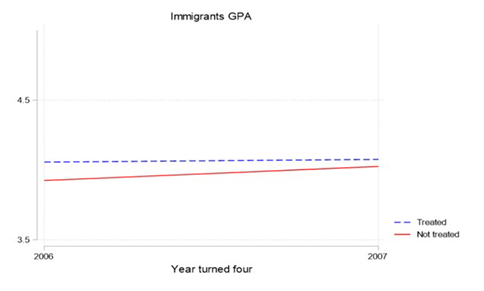
Fig 1.1
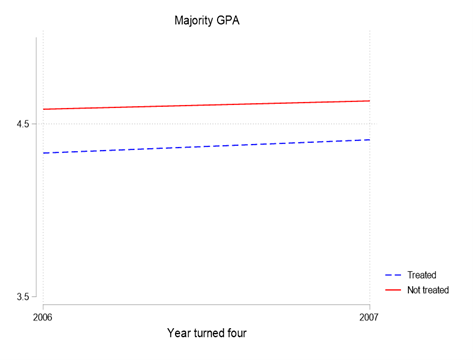
Fig 1.2
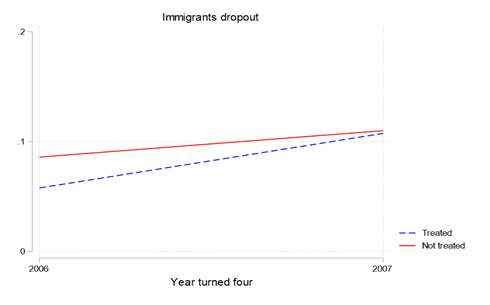
Fig 1.3
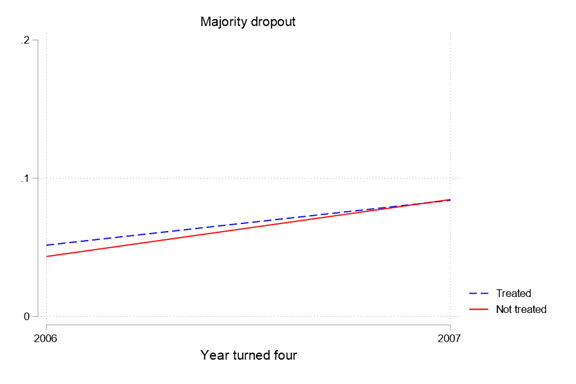
Fig 1.4
Figures 1.1-1.4 show the descriptive results for the majority and for those with immigrant backgrounds for the cohorts turning 4 the year before and the year prior to the reform.
As could be expected, there is no particular trend for the majority for any of the measures. For the immigrants and children of immigrants, the treated and not treated seem to become somewhat more similar after the implementation, but not in the direction you would expect if the reform had the anticipated effect. From these descriptive findings we would not expect any large effects of the reform this many years after it was implemented in the way we measure it here.
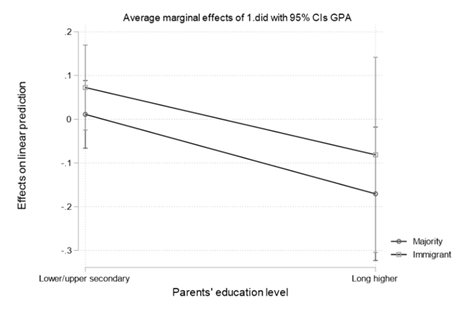
Moving on to the actual analyses, Figure 1.5 show average marginal effects of the interaction between the treatment, immigrant background and SES measured as parents’ educational level for the outcome GPA in 10th grade. The results are not significantly different from zero, but the direction of the coefficients are in the direction we could expect – the children with immigrant background and with parents with low education seem to have had the largest (but not significant) impact of the reform.
The figure also confirms that there is no significant effect (or even a slightly negative) of the reform for the majority or for those with immigrant background with high SES parents. This is consistent with previous research (Drange & Telle 2015; Drange 2023).
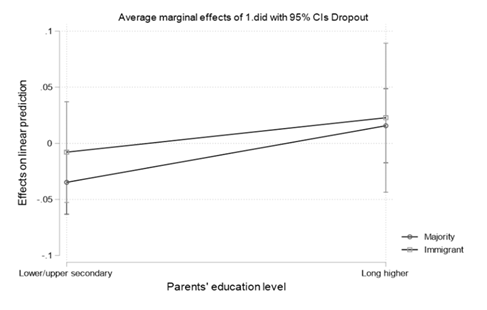
Figure 1.6 shows the average marginal effects from the measure of dropout in first year of upper secondary school. Again, we see no significant effects, and here the coefficients are not in the direction we could expect in terms of immigrant background, even if there seem to be the case that, even if not significantly different from zero, the children with parents with lower levels of education have largest impact of the reform in terms of less dropout. In sum, these results are as could be expected given previous research.
1.6.2 Interview results
Background
Person A explains that the introduction of the pilot project was part of a broader initiative aimed at improving quality of life in socioeconomically disadvantaged areas.
The selected pilot neighbourhoods were historically working-class areas that had, over time, seen an increase in immigrant populations due to low housing costs – something that also correlated with lower levels of education. At the time, a range of other challenges was also observed.
For instance, there was a noticeable prevalence of lifestyle-related diseases among some women, particularly gestational diabetes, which led to collaboration with hospitals and local health clinics. Many immigrants were also in need of job training.
In this context, the pilot was part of a larger investment in these communities, with free core kindergarten hours being one of several targeted measures. Although both interviewees emphasized language development to be one of the most important possible outcomes of the pilot, Person A explains: “What happened with this measure, what we call ‘free core hours’, was really part of something bigger – it was about improving life for people living in [area], and in the other districts as well.”
Neither of the interviewees could recall whether there was research conducted prior to the pilot. Both interviewees have been aware of the evaluations and studies conducted after the introduction of the pilot.
Recruitment
Since the reform was in a large extent designed as a measure to increase participation of migrant children in the kindergartens, the districts have launched an information campaign and reached out to families through various channels: Health stations, the district’s service squares, which provide information about municipal services (some of which have minority counsellors), school enrolment, mothers’ groups, adult education courses, home visits, posters and brochures, among other things, distributed in shopping centres, open kindergartens, and in addition, “word of mouth” is an important recruitment factor in all districts.
Person A, explains that in the initial stages of the reform, they understood the importance of direct engagement in reaching the right individuals for the reform, explaining, “We went door to door to make sure the families who needed it most were reached” and further “We carried out quite active outreach.
We went to people’s homes, knocked on doors and said: We have an offer of free core time for your four- and five-year-old.”
The information campaign involved also home visits of the implementation team to explain (mainly to the immigrant families) how the kindergartens are organised in Norway and encourage them to enrol their children. Person B also shared an experience from when the reform was expanded nationally.
They had spoken to a colleague in another municipality who had gained access to lists from the health centres identifying children not enrolled in kindergarten. This colleague took a proactive approach by going door to door, offering assistance with the application process.
However, Person B noted that this method required substantial resources, particularly because it often involved the need for interpreters. In addition, they explained how they reached out to “open kindergartens” (free, informal spaces where parents could bring their children to play).
This approach served as a “segue,” allowing parents to experience firsthand what kindergartens were like, with activities such as reading aloud and singing, which helped familiarize them with the concept of kindergarten, something that might have been unfamiliar to many.
According to Person B, the municipalities received funding earmarked for recruitment efforts. However, in order to avoid excessive bureaucracy, they were not required to report in detail how these funds were used. As a result, it becomes difficult to pinpoint exactly which measures were the most effective.
Challenges and discussions
When it comes to the implementation of the policy there was consensus across political axis. Person A explains when asked about possible debates: ”I actually have to say that there weren’t any debates, not many political disagreements … There was quite broad agreement.”
This is supported by Person B who explains: “There has been broad consensus on this. I think everyone has seen the common sense in doing something here.”
However, some emphasized the importance this would have in strengthening the Norwegian language of these children, while others were more focused on the impact this would have on getting women into the labour market.
Staffing
Lifting the economic burden from the parents in terms of the free access to kindergarten should be matched with access to good quality kindergartens. At the moment Norway suffers from the lack of kindergarten teachers. Person B explains that although Norway is a geographically vast country with many municipalities facing different challenges and financial situations, much of the necessary groundwork for implementing the reform at the national level was in place, at least on paper.
“I personally wish. That kindergarten was free for everyone. I think that Norway should actually afford it, because it is a big investment in the future. And, but then the kindergarten offer must also be good, and we now know that right now there is a bit of a crisis with this recruitment. The challenge for both kindergarten teachers and school teachers. That it is so, the number of applicants for the educations is going down, yes, 1/3 of students this year. One of them mentions that the starting salary for a kindergarten teacher is not bad but, but they have to do something about the conditions (…). They have so much responsibility so much they have to do and follow up, and that is also how it turns out. There are more children now with challenges than there were before.” (Person B)
However, the real challenges emerge in practice. Staffing levels in kindergartens are low, sick leave rates are high, and those working as preschool teachers face a heavy workload. At the same time, applications to teacher education programs for early childhood education continue to decline. According to Person B, the framework conditions are simply not good enough. Some measures were introduced in 2025 to improve the situation in socioeconomically disadvantaged areas, but significant challenges remain.
Accessibility
Both interviewees point out that kindergarten capacity and access to kindergarten places did not pose a problem in the district in question, as Oslo municipality already had an ambitious kindergarten policy involving both public and private providers.
“Oslo had a very ´aggressive´ kindergarten policy here, and they built a lot of kindergartens, and there were many private players who were involved and also.” (Person A)
Person A states that one of the key factors in actually getting people to send their children to kindergarten in the piloting project, the location of the kindergarten needed to be in “slipper-distance” to their home. If travel became too extensive, less people would take advantage.
This was also important for the kindergarten to be a meeting place in the community. Person B explains: “If the mother is already home with maybe a baby, and getting the three-year-old off to kindergarten—in winter, with poor transport—that just becomes too difficult.”
Both acknowledge that in other parts of the city, access to kindergarten places was more challenging, and that this may have affected the implementation. So full accessibility to a kindergarten close by became crucial. Person B explains how the national implementation of the reform became challenging in Sami areas in the north. In these regions, the distances were often too large, and bringing children along on the tundra was an important part of cultural education and traditional ways of life, something that did not align well with the structure and routines of kindergarten.
In terms of accessibility, Person A suggests that “simpler entry points” to apply for kindergarten could potentially help, as many families struggled with the digital application processes.
After agreeing to apply, he says:
“(…) then you have to apply in some way. Then you’re faced with a lot of information, and think many of the systems are—shall we say—somewhat intimidating and alienating? I think there should be simpler entry points. Like, if you became motivated, say through a visit to the kindergarten, and then you met someone there who could help you, and the children could stay behind, so to speak? In other words, there should be an easier way to handle this. And maybe this group isn’t really the most digitally inclined target group. But still, a lot has happened over the past 20 years with these immigrant groups, who were mainly the intended target group here. And I know—we know—that we need to do much better.” (Person A)
The system is quite complex and can appear both intimidating and alienating. However, they note that a lot has improved over the past twenty years.
Obligations for families partaking in the project
Person B explains that after the reform was implemented nationally, a conservative government introduced a policy requiring mothers who enrolled their children in kindergarten to attend Norwegian language courses as an activity obligation. This initially sparked concern within the ministries, where many feared such conditions might deter families from participating in the scheme if it came with strings attached.
“It was an interesting thing, and I guess it really was. (…) The Progress Party had the Minister of Children [then] and they come up with the suggestion that you should give free core time, but it should be linked to a duty for parents to be active. And then I remember that here we sat in a meeting with those in families with children the ministry and were all the bureaucrats were very anxious about what this would lead to, because we thought that now if there are demands made on parents to get this offer, they will say no thanks.(…) But instead, it turned out that Oslo municipality (…) Bergen, possibly also Drammen managed to set this up, so that language courses were given to mothers, while the child had free core time, and it was a great success. The parents who were asked saw it as a golden chance to get something they would otherwise not had a right to get (…)_And we sat a bit with our mouths open. It was just oi. This was a pleasant surprise, but then it ended after a while. It was just a time-limited trial attempt, or well, it wasn’t us who were responsible for it, so we were.” (Person B)
As explained by Person B, the measure was surprisingly well received by many mothers, who viewed it as a valuable opportunity, and it turned out to be more successful than expected. Unfortunately, it was only a time-limited pilot and was not continued.
Person B reflects that this might have been due to financial considerations. Many of the women in question had come to Norway through family reunification, which does not trigger the same economic entitlements as refugee status.
Additionally, there is often a diffusion in responsibility when it comes to different aspects of such complex policies. In this case, it was unclear who is in charge in the organization of different components: while the Ministry of Education oversees kindergartens, it does not have responsibility for parents—raising the question of who was actually accountable for following up on this initiative.
Room for improvements looking back
Extension from Two to Three Years
Although both interviewees agree that the reform was seen as successful both point out the age limit for children participating in the program. Person B believes that a three-year program, instead of two years, would have provided better results for the children’s language development, as the reform targeted children the last two years before they started school. “With everything we know about language learning and synapsis in the brain and so on, it would make sense to let them start earlier” person B explains. Person A confirmed this and mentioned that already early in the piloting phase, it became clear that offering three years of free core kindergarten time would be beneficial. Person A went on to explain that this was never really up for debate.
Further targeting
Furthermore, Person A suggests that the program could have been more targeted, for example, focusing on the most disadvantaged groups, although they acknowledge that targeting can be difficult to implement in practice due to the administrative challenges it entails.
Advice
Person A also emphasizes the need to strengthen newcomers’ understanding of the Norwegian system, as there are many small things we take for granted that can easily make someone feel excluded if they don’t understand them. “Those who understand the system shout the loudest and get the most,” they say, pointing out that this contributes to widening the gap.
This becomes evident later as well, for example in relation to the Norwegian State Educational Loan Fund (Lånekassen), which helps finance education. According to person A’s colleague, immigrants are overrepresented among those who struggle to meet the repayment requirements. In Norway, according to her, it is almost second nature to see the student loan as a debt that must be repaid and as a tool used to obtain an education. But this is not as clear for those who did not grow up here.
1.6.4 Media Analysis
“Free Core Hours” in Norway (2005–2011)
We have decided to search media content between 2005 to 2011. This is when the reform was first trialled in five districts in Oslo. Later the reform was developed, shifted, locally adapted and included additional components: the coverage was expanded to 4-and 3-year-old children, it was made universal in Norway in 2010, shifted from the universal coverage to being means-tested, it included training to teachers for supporting language learning for children with Norwegian as a second language, etc.
We limited the period of the analysis firstly because this period already included a large coverage of the topic and secondly, we were interested in researching the media coverage when the reform was new and needed support. Still, already between 2005-2011 the new ideas and shifts in the policy get reflected in the media. In this period, the focus of the reform was also more concentrated on the minority families. We chose to focus on six newspapers, four of which are national, and two which are specifically Oslo based, and one that is local to the area where this is implemented.
We chose the search using the keywords: “free core hours” and “kindergarten”. In terms of a quick quantitative overview of the media themes, the distribution was as follows:
Table 1.3: Media Coverage by Category (2005–2011)
| Theme / Category | Number of Articles |
| Political Issues | 143 |
| Social Issues | 133 |
| Education | 101 |
| Economy and Business | 12 |
As a general observation, we can state that from the first glimpse, there was a popular support for the ´Free core hours in kindergarten´ policy. It still was extensively used as a political tool in context of first general, and then local elections and was used as a background in the discussions on migration; Norwegian language vs. mother tongue, migrant integration; social inequalities; women´s labour market activation; youth criminality; crises related to the low numbers of trained educators and too few kindergarten places.
Below we follow the chronological and thematic development of the media discourses analysed by the OsloMet team. It seems to follow a logical development in the debate and shows the reform in the context of the parliamentary and local elections in the country.
2005 was the year of parliamentary elections in Norway, and most of articles mentioning Free core time in kindergarten related to it being discussed by several political parties as a part of their elections programme (especially on the red and green side, in other words in centre- Labour Party- Ap and left- The Socialist Left Party- SV).
Already at this point, the reform was mentioned by the politicians as a response to the issues relating to migrant integration, thus also the areas with the high proportion of migrants were set as the priority areas for piloting the reform.
In 2006, there are increasing discourses on the practicalities and debates on the perceived fairness of the reform, especially the universal cover of the reform was extensively discussed. It was designed to be offered to all families with children in the age of 5 in the chosen areas (with high representation of migrant families in Oslo), no matter what their socio-economic status was. In 2003-2007, Oslo City Council was governed by a coalition of right (Conservative Party- H) and right-wing populist (Progress Party- FrP) parties, while the parliament was governed by the coalition of the Labour Party, the Socialist Left Party and the Centre Party (known as the Red–Green Coalition).
As a result, there were some tensions around the policy between the parliament and the Oslo City Council. Initially, the interpretation of the policy by the authorities in Oslo was that the funding needs to be spread to Norwegian classes for migrant children across Oslo, but they were stopped by the parliament and asked to stick to the initial design of the policy, namely that it should cover only the 5 areas in Oslo. The City Council of Oslo argued that the universal coverage would spread the resources too thinly and would result in the lowered effect on the target group.
Representatives of the Labour Party rejected this argument claiming that – it would be unfair to provide an individualized special offer exclusively to children from minority backgrounds. In principle, the offer should be provided to everyone within an area [with high representation of migrants]. This argument is further discussed by other politicians and researchers as an important step away from ghettoisation of migrant children. They argue that a universal coverage should give a chance for a better integration of migrant children and majority children in the kindergartens (this issue is raised again in 2009 during the parliamentary elections debates).
Adding to this, in 2011 there appears to be a support for this argument in the observation that (seen in retrospect) the ‘core hours in the kindergarten’ policy prevented many majority Norwegians from moving from the districts within the policy trial because the offer of free kindergarten places was an attractive justification to stay. This in turn prevented the ghettoisation of these areas.
The importance of integration from early age is further raised in other contexts, including discussions around level of criminality among youth with migration background. Otherwise, 2006 was also a year when the local newspaper (Groruddalen) included descriptions of preparations for the introduction of the trial period and the initial ´successes stories´.
It is important to see the historical perspective. Here there are a number of people who do not have the culture that children should go to kindergarten, and when you also have systems that encourage children to stay at home, this is reinforced.(interview with Head of Department at the Directorate of Integration and Diversity, Randi Kleven, cf. ´Klart for tidenes satsing i Groruddalen´, Groruddalen. Publisert på trykk 16.08.2006, ´Bjerke-suksess´, Groruddalen. Publisert på trykk 14.09.2006, ´, fungerer – flere barn i barnehage´Groruddalen. Publisert på nett 01.07.2009 16:28.)
During the implementation period in 2006/2007, there were also articles expressing doubts over the effect of the policy, especially in terms of the challenges to integration of migrant children in kindergartens, and in consequence having limited effect on their Norwegian skills.
Some articles referred to the Danish case (Denmark introduced the reform before Norway) that showed that despite the higher participation in kindergartens, among the migrant children, there was little effect on integration and further on the language abilities of the migrant children, meaning that the minority and majority children do not play together.
The cost of kindergarten was not the only barrier for low participation among migrant families. Many families simply were not interested in childcare and opted for home care. Many sources from 2006 describe the efforts put by the districts into informing and active recruitment measures to engage immigrant families, through a number of different channels, which also included home visits. This was also extensively described by interviewee who was involved in implementation in one of the districts. This created a “culture of support”, where almost all relevant families ended up accepting the offer.
Moreover, through the ” Groruddal Dirtrict Initiative’, the kindergarten offer was combined with Norwegian language training for the mothers.
If we do not make better arrangements for the whole family, it will be difficult to demand that women be put to work. A comprehensive strategy that includes immigrant women’s opportunities for expanded childcare schemes, after-school care, a more comprehensive health service and other follow-up, is a clear prerequisite for this scheme to be a benefit for women and society..´Innvandrerkvinner og arbeid´,cf. Aftenposten. published 31.05.2007.
In 2007, discourse around the Free core time in kindergarten started to again revolve around the inclusion of all families who have low socio-economic status, not only within the areas of high representation of migrants. At the time, SV started to discuss in the media the idea that no family should pay more than 5 percent of their gross income for kindergarten.
2007 is also a year of the local elections in Norway, and therefore the policy is once again used in the political debates but this time on Oslo- and especially in district- level. This also potentially becomes a part of the reason of the shift from the sole discourse on immigration issue to the broader socio-economic matter for some politicians on the center and left. At the same time, the idea of expanding the policy to 3 year-old children is also more often discussed in 2007 also as a part of the political agenda for the local elections.
Towards the end of 2007, in the second year of the trial, the discourse moves towards the availability of places in the kindergartens. The successful recruitment campaign resulted in the kindergarten places quickly filling up, putting the pressure on the districts to open new places.
This year, the district of Grorud has created 88 new kindergarten places. If the district is to achieve full coverage of needs next year, the district must acquire about 340 new kindergarten places.
Large developments are planned, but we need more places than we have development plans for. We probably won’t reach full kindergarten coverage next year either,” states department manager Sidsel Krakeli in the district. (Chasing more places Neither have enough places nor enough preschool teachers ́, cf.
Aftenposten. published 13.12.2007. Side: 35)
This pressure and the quality of the kindergarten offer was also an important topic during the interviews with the policymaker.
This is a part of a broader problem in Norway and includes also the issue of a severe lack of trained educators both in kindergartens and in schools, as well as the reduced capacity of the health centres in Oslo which are responsible for mapping the development of language skills among children. These issues were largely in focus in 2008.
At the start of 2009, there is a series of articles describing the observations about children’s abilities to learn the language through play. These narratives coincide with discussions over spreading the trial to other parts of Norway. In 2009, there is also more focus on ‘free core hours in kindergarten’ and ‘cash benefits’ policies in the context of gender equality (the latter hindering the equality), and migrant integration (the former being seen as supporting integration).
There are more critical voices about the cash benefit as means to demotivate women (especially from ethnic minorities) from participating in the labour market. Cash benefit was defended in several articles by politicians from the Christian Democratic Party- KrF, who were its biggest supporter from the start.
Additionally, there was again parliamentary elections in Norway in 2009, and again the policy was used in the debates of the party programmes and again it was discussed in the context of migrant integration. At the same time, some parties (SV, Ap) begin to discuss the idea to introduce free afterschool homework help to increase equity among pupils. 2009 is also the first time (within the selected period) when the mother tongue of the migrant children is mentioned not only in the context of not speaking Norwegian but as something that could potentially to be supported.
This was discussed following the publication of the OECD report on ´Migrant education´ in 2009, which indicated that minority language children do significantly worse at school than other children.
The OECD (Organisation for Economic Co-operation and Development) believes that the Norwegian authorities are doing a lot of the right thing to counteract this, but at the same time believes that a number of findings are very worrying:
The average age of first-generation students who come to Norway is 10-11 years.
This group often does particularly poorly in upper secondary school, especially in vocational training.
Children with an immigrant background, especially children under the age of three, are clearly underrepresented in Norwegian kindergartens. Thus, many do not learn Norwegian before they start school. In primary school, minority language pupils score worse on reading tests. Cash benefits, access to kindergarten places and high co-payments are the main reasons why minority children do not attend kindergarten. These economic barriers should be removed, writes the OECD.
There is an increasing concentration of minority language students in certain parts of Oslo. The OECD is concerned that the city will be too divided, and that the immigrant population will be left alone. Schools with a large proportion of minority language students are given too few resources to deal with this.
Teacher education must be improved. Teachers today are not well enough equipped to meet the challenges in the classroom with minority students. For example, all teachers should have knowledge of how to teach Norwegian to people who do not have it as their mother tongue.
The major reform, the Knowledge Promotion Reform, delegated a lot of authority to counties and municipalities. Thus, there is also a big difference between the municipalities and how much resources they spend on facilitating increasing the learning outcomes of minority language students. There is also a lack of cooperation, especially between lower and upper secondary schools. (cf. Avslører klasseskille i skolen´, Dagbladet. Published 07.06.2009. Side: 6.)
In 2010, the debate about the mother tongue continues. There is some criticism of the sentiment that the mother tongue disturbs learning of Norwegian. At the beginning this portrayal is solely presented in the newspapers on the left side of the political arena.
But the general sentiment remains that the mother tongue is a private issue and only Norwegian language should be supported, this argument concludes that there should no longer be mother tongue assistants in kindergartens and the support should be directed instead to learning Norwegian (this, in turn, is later on in 2011 discussed as a challenge, as most of the substitutes for kindergarten teachers (70%) turn out to be Swedish).
In this context, 2011, the integration commission recommended ending the provision of mother tongue education for school children who speak Norwegian well enough to follow Norwegian lessons. The commission also recommend expanding the ‘free core hours in the kindergarten’ to younger children and to more geographical areas outside of Oslo.
There are also several articles that refer to the policy from the school´s perspective in the trial areas, stating the teachers’ observations that the children beginning school have a higher level of Norwegian since the start of the reform. One article describes how some kindergartens organise parenting courses for parents who use ´the core hours in kindergarten´.
1.7 Discussion and Conclusion
Our findings in this chapter confirm and extend what has been done in pervious literature examining the reform. Previous evaluations of the reform have generally shown positive effects on especially language tests among children with immigrant backgrounds with low socio-economic status up until 8th grade but did not show any significant effects on grades in grade 10 (Drange 2023).
The quantitative results in this chapter confirms this and did not find any significant results for dropout. They also suggest that, even if not statistically significantly different from zero, the reform has mainly had an effect on the targeted group of low SES children with immigrant background.
This supports earlier advices that attending pre-school is valuable in terms of improving later school results, and that targeting groups that do not use the offer could improve the chances of low SES and children with immigrant background, that are over-represented in dropping out of school and often have lower grades. Further quantitative research should investigate if the reform has had any impact on reducing drop out from upper secondary school altogether on grades in upper secondary school, and the likelihood of moving on to higher education for this group.
It is possible that even if the results are not statistically significant at this level of schooling, they will be at a later point in these children’s educational careers. More subjective measurements such as quality of life and school could also be investigated with survey data.
Although both the qualitative study and media analyses point to the general consensus around the implementation of the ´core hours in the kindergarten´ reform, they also provide some nuances in the political and practical context of the implementation.
The interviews shed light on the hands-on procedures the local practitioners carried in collaboration with the district authorities in order to inform the otherwise hard-to-reach migrant communities in their areas. This strategy seems to have contributed to the high uptake of kindergarten places among migrant children.
At the same time, the reform was developed, implemented and evaluated in the changing political setting both locally in Oslo, where the reform was initially trialed, and on the national level. Media analyses conducted within this study, show how the reform was discussed, criticized, adjusted and evaluated depending on the political scene at the time.
Migration, integration, language support, poverty, equity, fairness and the quality of education have been in the center of these debates widely discussed from the right to the left corner of the political scene in Norway.
Due to time restriction set in media analyses (2005-2011), this part of the study was not able to examine long term effect of the policy on equity in education. Still, it allowed scrutinization of the attitudes and expectations set out at the time of the pilot phase of the reform.
In our attempt to answer the question How was the reform portrayed in the media during the period of its initial trails we can say that, ´free core hours in kindergarten´, although generally accepted as an important and needed policy, was not immune to being used as a political tool and a channel to opinion expressions about migration, integration and societal fairness in the political programmes across the political spectrum.
From the local, bottom-up perspective, the articles relating to this reform pointed to particular challenges of the lack of qualified kindergarten teachers or limited access to kindergarten spaces.
One effect of the policy that was discussed in the media and which goes beyond the equity in education but has an indirect effect on it was the participation of parents, especially mothers, in the kindergarten.
For many of them, the kindergarten came to represent an important meeting place, a stimulus to learn Norwegian, and a place to practice the language. In this way, increasing the use of kindergarten among children with an immigrant background led to more contact with and more knowledge about Norwegian society, also for the parents.
Glossary
| Term | Definition |
| Norwegian Agency for Shared Services in Education and Research (SIKT) | Sikt is a government IT provider delivering national services for education and research. Their goal is to help institutions and researchers administering their data in a secure, ethical and legal way, and to share anonymized data. |
| Free core time (Gratis kjernetid) | The Norwegian government secures 20 hours of free core time per week for 2-, 3-, 4-, and 5-year-olds, and children with delayed school start, who live in households with low income. From August 1, 2024, families with an annual income under 642,700 NOK are entitled to free core time. From August 1, 2025, the income limit will increase to 669,050 NOK. |
Author(s) Presentation
Notes
- General Data Protection Regulation: regulation (EU) 2016/679 of the European Parliament and of the Council of 27 April 2016 on the protection of natural persons with regard to the processing of personal data and on the free movement of such data, and repealing Directive 95/46/EC
https://eur-lex.europa.eu/legal-content/EN/TXT/?uri=CELEX%3A02016R0679-20160504 ↩︎ - Due to a high risk of identifiability, we are unable to provide more details about the participants ↩︎