
Summary
’Gratis kjernetid’ [Free core time in kindergarten] is a policy designed to increase kindergarten participation in areas with a high proportion of minority language children. Children between the ages of 2 and 5 from families with an income below a given limit are entitled to a free core time (20 hours) in kindergarten per week. The income limit for free core time is set annually through the parliament budget resolution.
Free core time in kindergarten was a part of migrant integration policy.
Due to robust family support systems that help balance work and childcare, Norway exhibits some of the highest maternal employment rates in Europe. However, parenthood is linked to larger gender employment gaps among both native- and foreign-born parents compared with those without children. This association is generally stronger for foreign-born parents, whose average employment gap in the Nordic countries is 26 percentage points.
The Policy Cycle
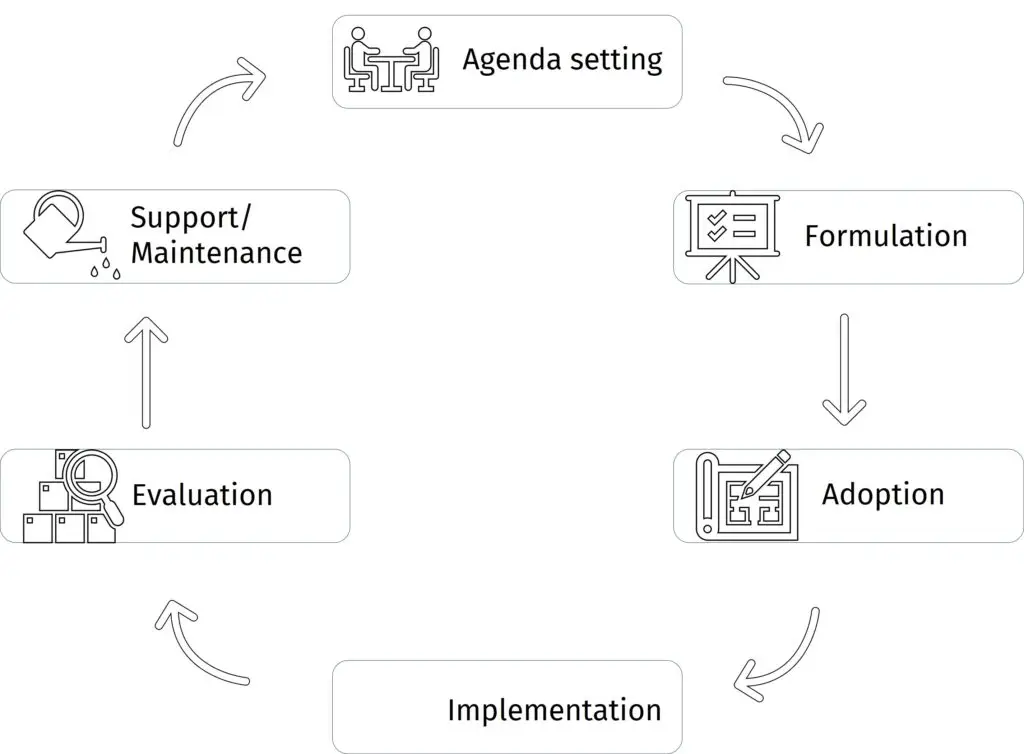
Agenda Setting
Problem
- Low kindergarten participation among children with immigrant backgrounds
- Need for better Norwegian language skills and social integration, as well as strengthened contact between parents and the kindergarten
Target groups
Children (especially four- and five-year-olds) in selected districts with a high share of immigrant families and lower participation.
Political context
Need to reduce social and linguistic disparities to strengthen later schooling and integration.
Evidence base
The assumption that increased kindergarten participation and language stimulation yield early gains in reading skills and school readiness.
Formulation
Main measure
Free core time (free half‑day offer) in kindergarten for four- and five‑year‑olds in selected districts of Oslo Municipality (Alna, Stovner, Grorud, Bjerke, and Søndre Nordstrand).
Instruments
- Remove financial barriers to participation (free core time)
- Language stimulation and multicultural pedagogy as part of staff capacity building in kindergartens
- Increased contact and collaboration between parents and the kindergarten
Program logic
Increased participation → better language and social competence → better results on early national tests → possible long‑term effect on school performance.
Planned evaluation design
Longitudinal follow‑up with a quasi‑experimental method (difference‑in‑differences).
Adoption
Decision
Launched as a pilot in Oslo from 2006 (partly 2007) in selected districts.
Financing and roles in evaluation
- The evaluation was financed by the Ministry of Children, Equality and Social Inclusion and the Ministry of Education and Research
- Statistics Norway (SSB) and Fafo conducted earlier evaluations
- SSB followed the children through the end of compulsory schooling on assignment from the Norwegian Directorate for Education and Training
Governance
Municipal implementation in collaboration with districts and kindergartens; national actors supported the evaluation.
Implementation
Geographic targeting
Selected districts with documented need.
Target group and intake
Four- and five‑year‑olds; active recruitment of families to increase participation.
Service content
- Free core time (half‑day) in kindergarten
- Competence development for staff in language stimulation and multicultural pedagogy
- Structures for increased parental contact (information, collaboration arenas)
Operational follow‑up
Registration of participation and outcomes to enable evaluation; coordination between districts and kindergartens.
Evaluation
Method
Difference in differences, comparing cohorts before/after introduction and against districts without the offer to control for underlying differences.
Early findings (earlier reports)
Positive effects on reading mastery in grades 3, 5, and 8; particularly large effects for children in low income families.
Later findings
- No significant differences in school outcomes at the end of compulsory schooling (final grades and national tests)
- No clear heterogeneous effects by gender, mother’s labor market attachment, mother’s education, or low income when looking at leaving grades
Interpretation and possible explanations
- Effects may fade over time (common in the literature on early interventions)
- Strong equalizing efforts in lower secondary school may mask early differences
- Measurement challenges: Reading proficiency levels are better captured by national tests than by transcript grades
- Possible “late reappearing” effects (e.g., completion of upper secondary or self regulation in adulthood) may only be studied later
Support/Maintenance
Operational support
- Stable and predictable funding for kindergartens in the target districts
- Continuous competence development in language stimulation and multicultural pedagogy
- Systematic parent cooperation and information work to ensure recruitment and participation
Quality and outcome monitoring
- Ongoing monitoring of participation and language/reading development
- Periodic evaluations to capture both short‑ and potential long‑term effects
Success Story
It’s not something you can just push a button for; many felt it was unnatural to send their children away.
We had a pretty good overview of all parents of young children [in the areas], and we worked quite actively with outreach. We went to people’s homes and knocked on doors, saying, “Here’s how it works, and we have an offer: you can get free core hours for your four- and five-year-old for two years,” explaining what that meant.
We visited to support and reassure these women so they would feel confident sending their children to this preschool. I’m quite sure that this very active outreach—and it was quite extensive; we’re talking about hundreds of visits—was one of the success factors in significantly increasing kindergarten coverage and building that sense of security. [a member of implementation team]
Barriers And Enablers
Factors that helped or hindered the reform/initiative and its effects.
Enablers
- Municipal funding for recruitment
- Reducing admin burden
- Active local outreach
- “Open kindergartens” as a bridge for families to introduce tchem to the concept
- A supportive media narrative and a policy framing that shifted from “integration only” to “tackling social inequality,” which helped to legitimise the policy
Barriers
- Staffing shortages
- Diffuse accountability across ministries for complementary measures
- Uneven accessibility: distance and capacity constraints outside some Oslo districts
- Complex application processes: digital systems felt intimidating; need for simpler entry points and interpreter support
Potential for transfer to other (national) contexts (lessons learnt)
- Proactive outreach to families (e.g., home visits and multi-channel information campaigns)
- Linking child participation with parental engagement opportunities (e.g., language courses for mothers)
- Anticipating and funding capacity expansion: successful recruitment will fill places, so plan for new slots and addressing early childhood teacher shortages
- Providing teacher training focused on language stimulation and multicultural pedagogy to align practice with goals
- Aligning with related policies to avoid conflicting incentives (e.g., cash benefits that reduce kindergarten use)
- Supporting newcomers’ navigation of systems: simplify processes and providing information/interpretation
- Plan for supportive services capacity (e.g., health centers involved in language screening) so complementary systems can meet increased demand
- Building rigorous evaluation into scale-up (quantitative and qualitative) to track long-term outcomes (e.g., later grades, completion)
- Cultural norms need adressing (e.g., part-time uptake, maternal employment expectations) to maximize effective exposure