Case study 3
User Task
A user seeks to explore educational policy reforms in Hungary using the STRIDE platform. Starting from the Explore the Indicators interface, the user clicks on Explore the reforms, which redirects them to the Policy Reforms interface. This environment enables users to analyse reforms across countries using multiple filters and interactive features.
Step 1: Exploring reforms through filtering
Within the Policy Reforms interface, the user selects Hungary and applies filters such as year, educational level, and evaluation outcome. These controls allow the user to explore how many reforms have taken place in Hungary under different conditions.
By adjusting these filters, the user can identify patterns in reform activity, for example, focusing on specific educational levels (e.g., primary or secondary education) or narrowing the view to reforms with particular evaluation outcomes. When hovering over Hungary on the map, the interface displays the number of reforms corresponding to the selected criteria, providing an immediate overview of reform activity.
The user may also filter by positive evaluation to identify reforms that could serve as potential best practice examples.
Step 2: Accessing detailed reform information
The user clicks on Hungary and selects the information icon, which opens a detailed panel displaying the country’s reforms. This includes all the reforms implemented and respective information such as the title, year, educational level, aim, key actions, and evaluation of each reform.
The interface allows the user to: Scroll through all available reforms, use the search functionality to locate specific reforms (e.g., those targeting particular groups such as Roma students), and examine reforms across different time periods and policy areas.
This enables a structured and efficient exploration of Hungary’s reform landscape. The user can select the PDF or the Download option to export the list of reforms for Hungary. This generates a document containing detailed descriptions of the reforms, which can be used for further analysis or reporting.
Step 3: Country-level and European-level comparisons
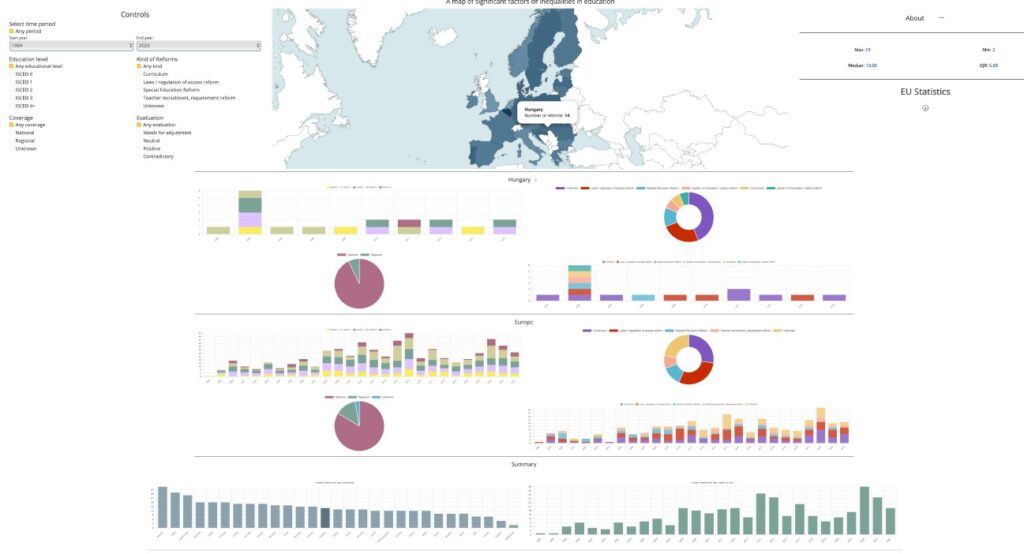
Below the map, the platform provides country-level visualisations, summarising reform activity in Hungary.These visualisations allow the user to explore:
the number of reforms over time and the distribution of reforms by type and educational level. The platform offers a European-level overview, aggregating reform data across all countries. This enables users to: examine how reform activity is distributed across Europe, compare Hungary’s reform activity with other countries, identify broader trends, such as the frequency of reforms by type or period.
The country-level visualisations for Hungary show that reform activity is distributed across multiple years, with periods of increased activity embedded within years of fewer reforms. The distribution by educational level indicates that reforms are spread across ISCED levels, with some concentration in primary and lower secondary education.
The breakdown by reform type suggests that Hungary’s reforms are diverse in nature, including categories such as laws and regulations of access, curriculum reforms, and special education reforms, rather than being concentrated in a single policy area. The evaluation distribution shows a mix of outcomes, including positive, negative, and contradictory evaluations, indicating variation in how reforms are assessed.
The coverage distribution highlights that the majority of reforms are implemented at the national level, with relatively limited representation of regional initiatives.
At the European level, the aggregated visualisations show that reform activity varies substantially across countries, with some countries implementing a significantly higher number of reforms than others. Hungary appears to fall within the mid-range of reform activity, rather than being among the most or least active countries. The summary chart of total reforms by year indicates that reform activity across Europe fluctuates over time, with certain years showing higher concentrations of reforms.This provides additional context for understanding Hungary’s reform timeline within broader European trends.
Click the map below to watch this use in the Interactive Map