Use Case 2 with evidence from Hungary
User Task
A user seeks to investigate whether parental education background is associated with differences in reading achievement among primary education students in Hungary using the STRIDE map. The platform provides access to comparative data on student performance across countries and population groups, enabling the exploration of disparities linked to socio-economic characteristics.
Step 1: Identifying subgroup differences
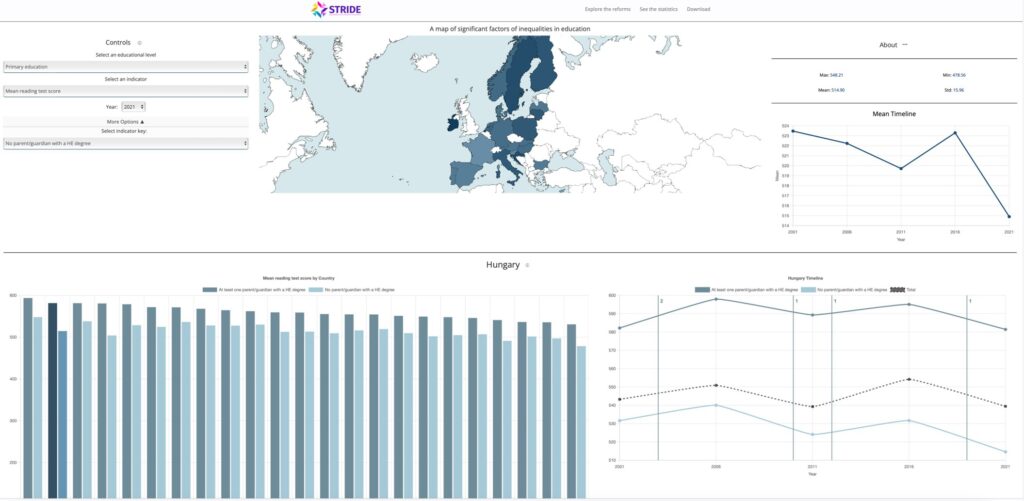
According to the visualisation, primary students in Hungary consistently perform differently depending on parental education background, with a clear and persistent gap between the two groups. Students with at least one parent or guardian with a higher education degree outperform those without such a background in all observed years.
The longitudinal trend shows that both groups follow relatively stable trajectories over time, with some moderate fluctuations in performance. Students with higher-educated parents maintain consistently higher reading scores, while students without such a background remain at a lower level throughout the period. The gap between the two groups is stable and substantial across all years, with no reversals in performance ranking. While overall scores vary slightly over time, the relative difference between the groups remains largely unchanged.
By the most recent year, the difference between the two groups remains clearly visible, indicating that disparities associated with parental education background persist over time without meaningful convergence.
Step 2: Cross-Country Comparison
The user expands the view to include multiple countries by examining the bar chart. The system enables comparison of Hungary with a range of European countries, revealing clear differences in the magnitude of inequalities associated with parental education background.
In 2021 and in countries such as Bulgaria, a noticeable gap between students with and without higher-educated parents is visible. In contrast, countries such as Finland the disparities between are smaller.
Across all countries in the chart (and all years) students with at least one parent with a higher education degree consistently outperform those without.
This comparison allows the user to assess how inequalities related to parental education background vary across national contexts. Hungary appears to follow a pattern common to many countries, with a clear disparity between the two groups.
Step 3: Linking Inequality Patterns to Reforms
The system overlays reforms occurring in the same period and the respective educational level aligned with the timeline. The user can click on the reform lines to access details-on-demand (e.g., policy aim, coverage, etc.).
By examining the timeline, the user identifies several reforms in Hungary during the observed period, including Defining basic concepts of equitable education (2003), the Integrated pedagogical system (2003), the Conditionality of family allowance upon school attendance (2010), the Centralisation of the school system (2012), and the Introduction of State-funded study halls (2019). These reforms are displayed alongside the evolution of reading performance for students with different parental education backgrounds.
Click the map below to watch the case in the Instructional Map.