Socio-Economic Status (SES) and Inequality in Mathematics Achievement in Secondary Education: Evidence from Hungary
A user seeks to investigate whether SES is associated with differences in mathematics achievement among 15-year-old students in Hungary using the STRIDE map.
Step 1: Identifying subgroup differences
The user selects Secondary education and Mean mathematics test scores (PISA – SE) from the control panel. To ensure the appropriateness of the selected indicator, the user can consult the additional metadata via the About option. The user then selects the most recent year and, through the More options menu, filters the data by subgroup, choosing the category At least one parent/guardian with a higher education degree.
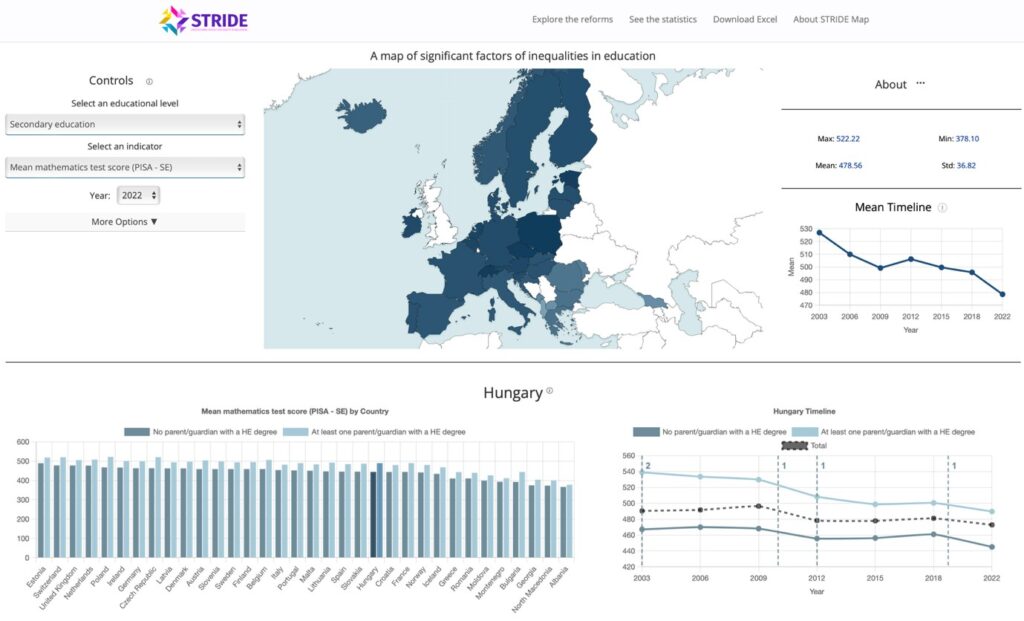
According to the visualisation, students in Hungary with at least one parent or guardian with a higher education degree consistently outperform those without one across all observed years.
The gap between the two groups is clear over time, although it narrows after 2012. Apparently, both groups show a gradual decline after 2012. This allows the user to conclude that SES is potentially a persistent determinant of student mathematics performance in Hungary, with students from higher-educated family backgrounds consistently achieving higher scores.
Step 2: Cross-Country Comparison
The user expands the view to include multiple countries by examining the bar chart. The system enables a comparison of Hungary with other European. The consistent pattern is that high-SES students outperform low-SES students in every country shown.
This comparison allows the user to assess how the magnitude of inequalities associated with SES varies across national contexts. In 2022, Hungary appears to fall in the middle of the country distribution, with a comparatively smaller gap between high- and low-SES students.
The disparity in Hungary seems smaller than in countries such as the Czech Republic, Austria, Belgium, Slovenia, and Poland, where the difference between the two groups is more pronounced.
However, Hungary’s gap appears larger than in lower-performing countries such as Albania, North Macedonia, Georgia, Montenegro, and Moldova, where the difference between high- and low-SES students is relatively narrow.
Step 3: Linking Inequality Patterns to Reforms
The system overlays reforms occurring in the same period and at the respective educational level, aligned with the timeline.
The user can click on the reform lines to access details on demand, such as policy aims, coverage, and other relevant information.
By examining the timeline, the user identifies three reforms in Hungary during the observed period relating to the specific educational level, including the Conditionality of family allowance upon school attendance in 2010, the Centralisation of the school system in 2012, and the Introduction of State-funded study halls in 2019.
These reforms are displayed alongside the evolution of mathematics performance for students with high- and low-SES.
A potentially relevant reform to inspect is the Centralisation of the school system in 2012, since the reform aimed to address inequalities caused by post-1989 decentralisation, including disparities in funding, school quality, and access linked to socioeconomic status and ethnicity.
From this page alone, we can only say that the reform coincides with a period when the SES gap narrowed, while overall mathematics performance declined for both groups. The reform’s visible evaluation is negative, which is worth reading alongside the trend.
However, the chart cannot prove that the reform caused the observed changes in scores.
Click here or the image to watch the study in the Interactive Map. The image should change to: