
Summary (Sure Start)
Reform
Launched in England in 1998, the Sure Start Intervention sought to provide comprehensive support to families with young children in disadvantaged areas, giving them the best possible start in life.
Sure Start programmes offered core services like outreach, play and healthcare, along with additional services designed to meet local needs.
The physical embodiment of the Sure Start programme is Sure Start Children’s Centres (SSCC), central activity hubs which provided integrated services.
National Context
Sure Start’s origins lie in the then Labour government’s emphasis on social inclusion and commitment to tackling childhood poverty.
While drawing inspiration from existing early childhood programs both domestically and internationally, Sure Start aimed to establish a more integrated and holistic support system.
This multifaceted approach reflected the understanding that child development is influenced by a range of interconnected factors, including health, social, emotional and cognitive development.
The Policy Cycle
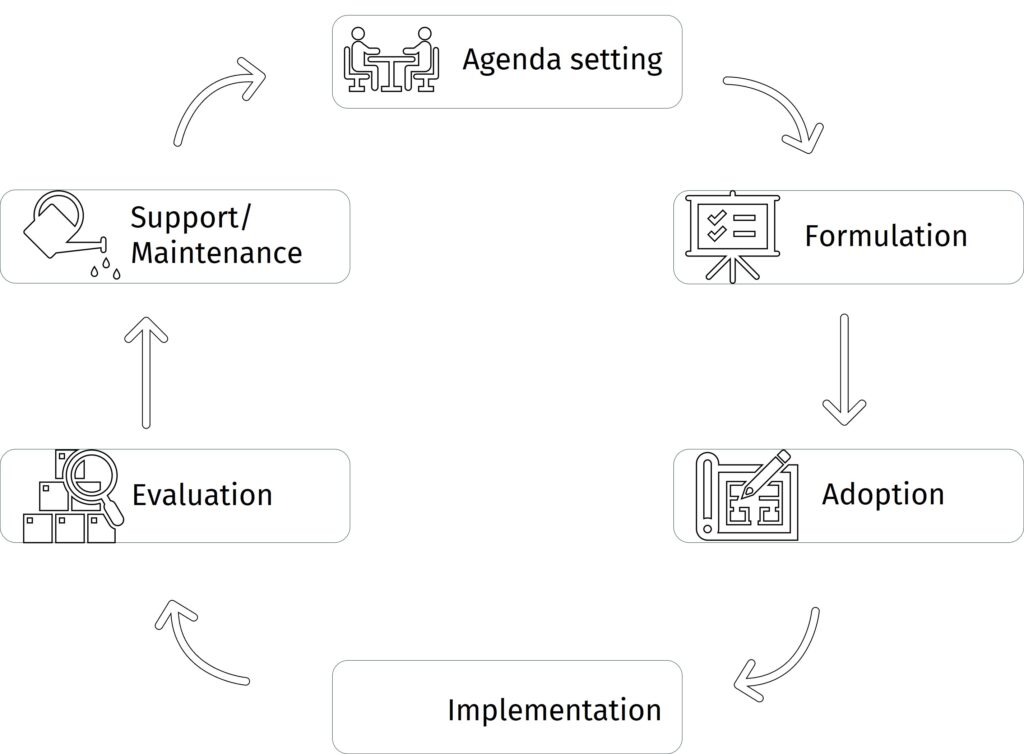
Agenda Setting
Problem
The pervasiveness of educational inequalities among students facing disadvantages and their more affluent peers.
Target Groups
Sure Start intended to support children under five and their parents, especially in deprived areas. However, the programme was branded as universal to reduce stigma for impoverished families.
Political Context
The then Labour Government’s emphasis on social inclusion and commitment to tackling child poverty.
Evidence Base
Sure Start had ample funding and faced political support due to evidence from reports which emphasised the significance of ECE for mitigating gaps in childhood inequalities.
The United States’ Head Start policy and various local initiatives provided models for Sure Start.
Formulation
Main Measure
Children’s Centres were the physical embodiment of Sure Start. These centres offered children under five and their parents’ access to early education, healthcare, play, familial programmes and other services based on local need.
Instruments
- Integrated services, spanning education, public health and family support
- Beneficiary involvement from the earliest stages of policy formulation to adequately address local need
- “The ideal Sure Start from the very beginning was run by a local board that included health, education and social care, but also had to include local parents” (Eisenstadt, Retrieved from interview data)
Adoption
Decision
In January 1999, the first 60 Sure Start districts were announced based on high levels of deprivation and existing early years support.
Financing and roles in evaluation
The Labour and Coalition Governments each commissioned the National Evaluation of Sure Start (NESS) and Evaluation of Children’s Centres in England (ECCE) to determine impacts of Sure Start.
Governance
Local bodies set up Sure Start boards with parents and other stakeholders to determine community priorities and services that would be offered. Despite local discrepencies, all Sure Start Programmes were required to offer 5 core services:
- Outreach and home visiting
- Support for families and parents
- Good quality play
- Learning and childcare
- Healthcare and support for those with special needs
Implementation
Geographic scope
Across England with a particular emphasis on deprived areas.
Target group and intake
Sure Start Programmes were located in highly disadvantaged communities to promote accessibility.
Stakeholders used assertive outreach techniques to effectively target children under 5 and their families with the most needs.
Service content/ Actions
- Sure Start Children’s Centres (SSCCs) offered 10 hours of childcare per day
- SSCCs acted as advice hubs for parents with children under 5
- Offered community healthcare, special needs support, employment support and outreach and home visiting
- Facing concerns that Sure Start was not effectively reaching the most disadvantaged families, government provided additional funding for outreach activities and ensured a minimum of two outreach workers in the most disadvantaged areas
Evaluation
Methods
The National Evaluation of Sure Start included longitudinal, quasi-experimental methods, comparing children in SSLP areas with non-SSLP children and their families, with similar characteristics, using the Millennium Cohort Study.
The Millennium Cohort Study, enabled Sure Start evaluations, as this data allowed for direct comparisons between Sure Start and Non-Sure Start participants when randomised controlled trials were not possible due to localised design.
Early Findings
The first major report, published in 2005, found few significant effects of Sure Start Local Programmes. A major concern was evidence that the most disadvantaged families were being adversely effected by close proximity to SSLPs.
A follow-up report revealed more positive impacts like better social development and less chaotic home environments.
Later Findings
A recent study conducted by Carneiro et al. (2024) found that access to a Sure Start centre between the ages of 0 and 5 significantly improved the educational achievement of children, with benefits lasting at least until their General Certificate of Secondary Education (GCSEs, age 16).
Children who lived within a short distance (2.5 kilometres) of a Sure Start centre for their first five years performed 0.8 grades better on their GCSEs.
Support/Maintenance
Maintainance
Around 2015, Sure Start Children’s Centres began to fizzle out due to budget cuts and lack of enshrinement into legislation.
Results
Sure Start was widely popular and supported by policymakers, stakeholders and beneficiaries.
Sure Start emphasised the significance of beneficiary involvement and implementation of children’s centres as key to early childhood provision.
Current Challenges
Re-instating Sure Start or an adjacent ECE provision to target growing levels of childhood inequality.
Success Stories
“I think one of the key features [of sure start] was dignity and respect for beneficiaries, which isn’t always the case in public service.” (Naomi Eisenstadt, First Director of Sure Start)
“It was a lovely job to have. I’d go around the country saying ‘this is the new frontier of the welfare state.’ That is what I thought it was. And I just never, ever thought that it would be destroyed and dismantled. And even today Sure Start still resonates in a positive way.” (Baroness Margaret Hodge, Children’s Minister from 2003 to 2005)
On collaboration with voluntary organisations and stakeholders: “I think it’s really important because you get perspectives in terms of the experiences of those organisations and the people working within them you can’t get in any other way. You can’t get it from professionals working in organisations as sympathetic and empathetic as they may be, you get it from the people with lived experience.” (Baroness Beverly Hughes, Minister for Children, Young People and Families from 2006 to 2009)
Barriers and enablers
Factors that helped or hindered the reform/initiative and its effects.
Enablers
- Ample treasury funding and support for early years
- Evidence of best practice from previously piloted international and national initiatives
- Beneficiary Involvement
- Public support and popularity
- Accessibility of longitudinal data for evaluations
Barriers
- Lack of programme uniformity for implementation and evaluation fidelity
- Lack of statutory enshrinement for the continuation of programmes
- Shifting political powers and agenda setting
Potential for transfer to other (national) contexts (lessons learnt)
Despite mixed outcomes, the Sure Start Policy, and its model in particular, was highly influential in England and globally. Sure Start emphasised:
- The significance of cross-sectorial ECE models for accessible, holisitc care to the most disadvantaged groups
- The significance of beneficiary involvement and localised components of ECE to directly target local needs
- The significance of accessibility of longitudinal, national-level data for evaluations when randomised-controlled trials are not possible
- The significance of statutory enshriment to ensure the continuation of successful programmes