
Summary
Reform
Mandatory kindergarten (pre-school) from the age of 3 was introduced in Hungary in 2015 (codified by the Act CXC of 2011 on Public Upbringing ). In practice, this means that every child has to enroll in kindergarten in the academic year starting after their 3rd birthday (unless the family requests and receives exemption until age 4 based on personal circumstances).
Produced in line with the Hungarian National Social Inclusion Strategy (2011), the policy has the explicit aim of a positive impact on the educational and social development of disadvantaged and specifically Roma children.
National context
In Hungary, kindergarten (ISCED 0, for children aged 3–6) is part of the school system. Attendance had been mandatory from the age of 5 since 1996 and kindergarten attendance has been traditionally high. The majority of kindergartens are maintained by local municipalities, however, between 2010 and 2022 the ratio of children attending church-run and private institutions multiplied.
This trend has contributed to social segregation and an unequal share of resources among kindergartens of different maintainers, further exacerbated by geographical inequalities of teacher shortage and other resources.
Policy Cycle
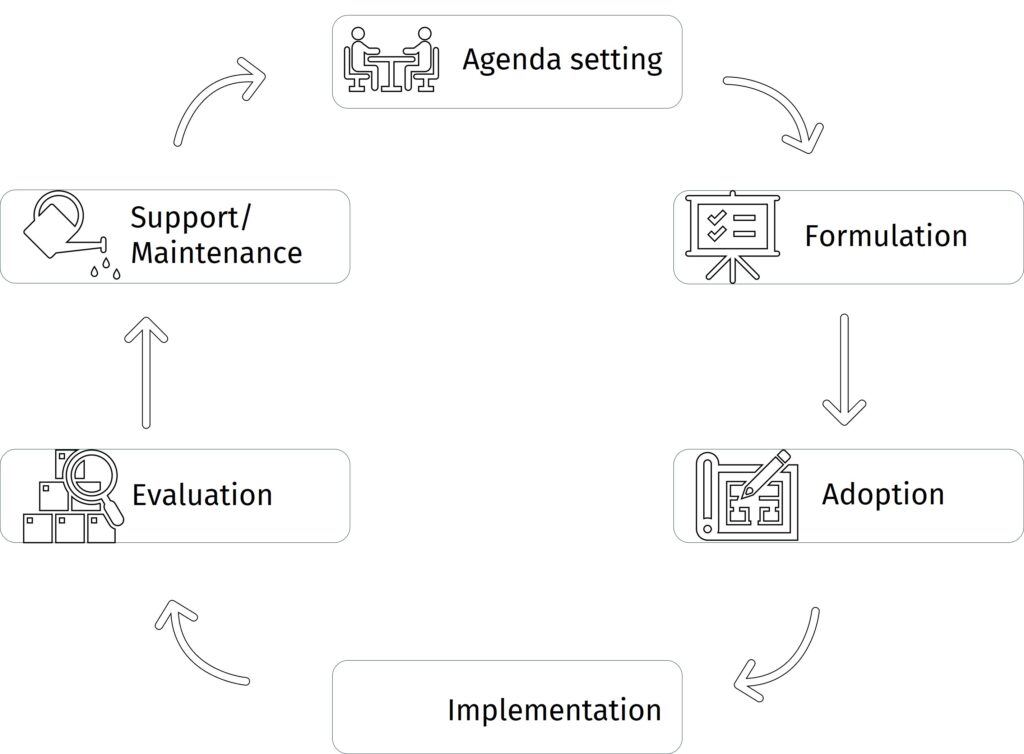
Agenda Setting
Problem
Lower kindergarten attendance rates among Roma and poor families, especially in smaller, secluded settlements + generally extremely high educational inequality in terms of socioeconomic status and ethnicity – need for early intervention.
Target groups
3 to 4-year-old children, especially in families that used to not support kindergarten attendance (e.g. non-working parents) or in regions with lower access.
Political context
The policy was highly influenced by the European policy context: the focus on ECEC as equalizer and the introduction of the EU Framework for National Roma Inclusion Strategies.
In parallel with this policy, in other areas of education opposing trends began, e.g. centralization, decreasing mandatory schooling age.
Evidence base
Policymakers referred to international trends (e.g. OECD, Eurostat and Eurydice data) that supported the expansion of kindergarten attendance for the sake of equality, and called it a “professional consensus” that such measures are useful.
Formulation And Adoption
Main measure
Mandatory kindergarten attendance for all children who turned 3 by the beginning of the academic year for at least 4 hours/day.
Instruments
- Infrastructural developments (building, expanding and renovating kindergartens)
- Methodological support for teachers (trainings)
- Administrative background (for example, if a family wants exemption from the obligation, they need to apply to the notary of the local municipality)
Implementation
Geographical scope
Across the whole country – universal measure
Target group and intake
Focusing on 3 to 5-year-olds, many of whom had already attended kindergarten before the implementation of the new policy.
Service content
- Increased participation in kindergarten (need of more space and teachers – the latter has proven problematic)
- Facilitating teachers’ further training
- The content of kindergarten education did not change as a result of the policy
Evaluation and Support/Maintenance
Missing evaluation
There has not been any large-scale measurements of the impact of the policy or any evaluation of its effects conducted either by governmental bodies or independent researchers.
Support/maintenance
The policy has been widely accepted by professionals and the general public alike, and it has become a core element of the school system.
Success Stories
Succes Story # 1: Preparation
“The direct connection between [decreasing school selectivity] and kindergarten attendance […] is hard to measure; it’s more like a hypothesis. […] [But we received] very positive feedback from the EU that this would be an acknowledged and important endeavour. At every negotiation and professional consultation we had with the EU, it was confirmed that they thought this was the right direction.” (Government-level interviewee, active in 2010-15)
Success Story # 2: Reception
“I believe this is a great thing that nobody has debated this policy initiative since then. The only debated aspect was the lack of infrastructural conditions, or rather, there was a scaremongering in society that it would not work anyway. As far as I’m following the political and professional literature and reactions since the introduction, there has not been any serious debate about this policy.” (Government-level interviewee, active in 2010-15)
“In our close community, it had an effect for sure. When I think of those mothers who had a hard time with separation, we saw things like mothers bringing each other to the kindergarten and reassuring each other that things would be fine. […] But for that we also had to speak to them first about the positives.” (Kindergarten head from a segregated neighbourhood)
Barriers And Enablers
Enablers
- Supportive EU policy framework
- Already existing tradition and infrastructure of kindergartens (high attendance rates)
- Funding and political willingness for infrastructural developments
- Support from professionals and acceptance among the majority of society
Barriers
- Unique measure: equalizing elements are missing from policies regarding other levels of education, therefore the impact is highly limited
- Teacher shortage
- A lack of significant methodological modernization and individual treatment for children who need development
Potential for transfer to other (national) contexts (lessons learnt)
- It can be a hindering factor in other countries if the kindergarten system is underdeveloped and there is no tradition for the state to provide the funding for free access to all children, and/or for families to accept and welcome the obligation of enrolling children in kindergarten
- As a universal measure, it has had the positive aspect of not causing tensions between different social groups (that a targeted measure/support scheme might).
- The most important weak spot of the policy is its uniqueness within the wider framework: other measures do not enhance equality in the education system.
- To fully achieve the equalizing potential of kindergarten, methodological modernization in teaching practice would be necessary (quality as well as quantity).
- The lack of measurements at entry point as well as longitudinally once the policy was introduced significantly reduces its replicability