
Summary
Reform
Mandatory language assessment in Grade 0 is a universal national reform introduced in Denmark in 2009.
It requires all children in public schools to undergo language screening at the start of compulsory schooling, with the aim of identifying language difficulties early, standardizing previously uneven local practices, and informing subsequent pedagogical responses.
National context
Denmark has a universal, publicly funded early childhood and school system. In 2009, as part of a broader shift towards early intervention and school readiness, Grade 0 became the first year of compulsory schooling and language assessment was made mandatory in public schools.
The reform was introduced in response to concerns that early language difficulties and unequal preparedness at school entry could contribute to later social inequality in education.
Policy Cycle
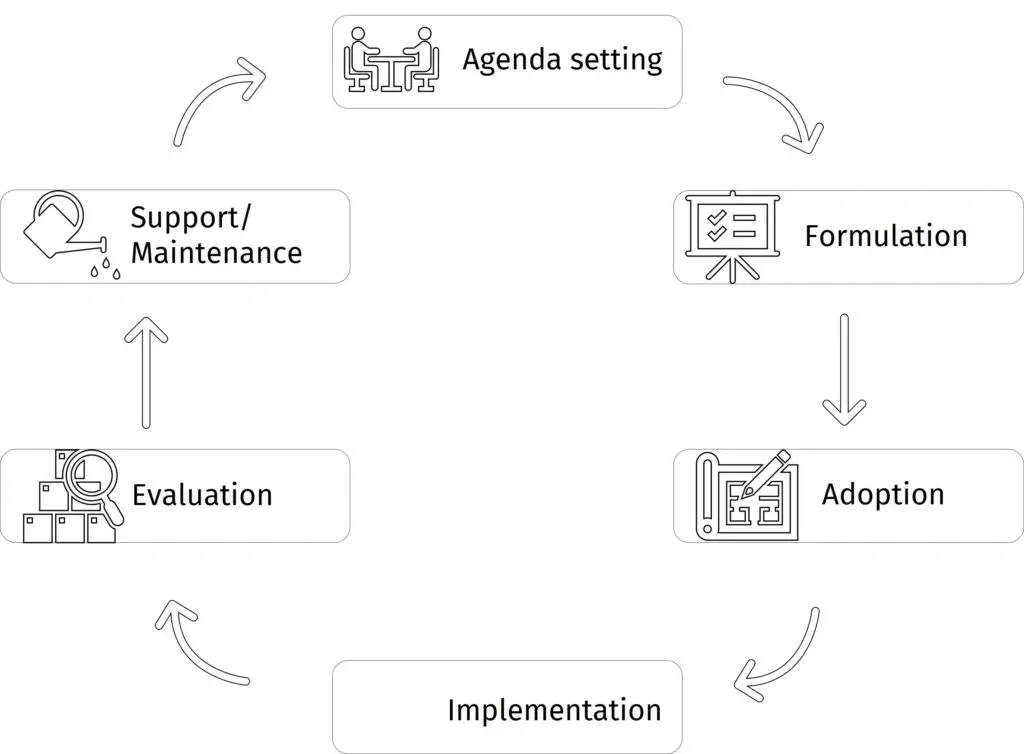
Agenda Setting
Problem
Social inequalities in early language development and school readiness; need for earlier detection of language difficulties and more equal educational opportunities at school entry.
Target groups
The reform was universal and covered all children in public schools entering Grade 0, but it was especially relevant for children from low-income families, low-education households, and immigrant backgrounds.
Political context
To “level the playing field” by identifying language difficulties earlier and reducing gaps in preparedness at school entry.
Evidence base
Research-informed assumption that earlier and more systematic language assessment would enable earlier support and improve children’s later educational outcomes.
Formulation
Policy design
Universal mandatory language assessment for all children entering Grade 0 in public schools, introduced in 2009.
Instrument
Language assessment as a common national requirement at school entry; the reform standardized the timing and content of screening, but did not prescribe one specific assessment tool or procedure.
Results had to be documented in the child’s individual learning plan (elevplan).
Rationale
Early identification, improved possibilities for pedagogical responses to children’s language needs, and more equal starting points in compulsory schooling.
Adoption
At the time of original implementation the language assessment test tool was not uniform in terms of test design, test execution conditions or test format (digital, non-digital).
Decision making were left to local municipalities with different prioritisations in resource allocation, test and platform providers and with different degrees of prior experience with language assessment (ranging from no noteworthy experience to significant experience).
Implementation
Geographic targeting
- All public schools nationwide
- Private schools were not covered
Target group
All children entering Grade 0 in public schools.
Content
- Mandatory Grade 0
- Language assessment at school entry
- Results recorded in the child’s individual learning plan (elevplan)
Implementation model
- National mandate with local implementation;
- No single prescribed test tool
Local discretion
Follow-up and pedagogical use of results were left to municipalities and schools.
Evaluation
Research design
Multi-method study combining quantitative analysis, qualitative interviews with policymakers and practitioners, and media analysis.
Effect identification
Interrupted time-series models with school-cohort fixed effects applied to register data from Statistics Denmark.
Outcome
9th grade GPA
Main finding
The reform was associated with a small but statistically significant improvement in GPA.
Heterogeneous effects
Particularly strong benefits for students with immigrant backgrounds; stronger effects also for low-income students.
Interpretation
Universal early assessment appears to have produced modest long-term gains, especially where it improved early identification for groups with greater language-related risks.
Possible explanations
- Greater visibility of language needs
- Stronger institutional responses for some groups
- Variation in local implementation and responses
Caution
The effect reflects a broader 2009 reform package, including compulsory Grade 0.
Support/Maintenance
The reform has been supported since the time of implementation through both ministerial measures (particularly “STUK”, Ministerial Department for Education and Quality) and local government measures, such as knowledge sharing seminars facilitated by state or local resource personnel and the teachers responsible for local classroom execution of the tests.
The language assessment test itself has furthermore been supported and maintained by for instance Trygfondens Børneforskningscenter (Child Research Centre funded by Trygfonden) on a continual basis with ongoing development of the test and yearly evaluation of the test tool kit.
Trygfondens Børneforskningscenter has eventually won the tender and is currently the sole actor responsible for developing the test.
Success Stories
Success Story # 1
“Of course, it’s not a guarantee that you’ll identify all the children anyway, because that’s just the nature of language development – there are simply children who develop later, and every instrument has its limitations. Still, it is often perceived that way.
As for the further developments that have taken place, you could say that the feedback from the Language Council on the new digital language assessment in kindergarten class has been very positive. I’m genuinely very positive myself – people really feel that it has been an improvement. It’s both a professional improvement and an improvement in terms of implementation, and the children simply find it much more fun.
So in that sense, I think there are many signs that it is an improvement. But naturally, as is the case here and everywhere else in the world, not everyone thinks it’s a good idea. There is still quite a bit of misinformation – misunderstandings about what a language assessment can actually do.” (Informant 3)
Success Story # 2 (The reform in a critical lens)
“So what is actually the most important thing? Is the most important thing that we can collect national data, so we can monitor, oversee, figure out what’s happening, and track it?
That is important, because sometimes we do lack that sense of “How is it really going?”. But fundamentally… the most important thing should be that you can carry out a language assessment.
That you can actually say something about the individual child, so you can initiate the right intervention for that child – and those two things don’t necessarily always align very well.
Because every time something is aggregated, some nuances are lost. And if you design a language assessment tool that makes it easier to aggregate data, it might not be the best tool for the individual.” (Informant 1)
“Well, I think that if we could increase the focus on interventions? Because, as the saying goes, the pig doesn’t get heavier just by being weighed.” (Informant 2)
Barriers And Enablers
Enablers
- Greater national standardisation and comparability across municipalities
- Political and institutional support for early intervention and school readiness
- Academic support at local and state level
- Ongoing academic evaluation and continuous development of the test by researchers
- A common national framework for early identification of language difficulties
Barriers
- Lack of formalized and quality-assured follow-up
- No clear legal specification of post-test language support
- Strong municipal variation in implementation
- Initially limited standardization of test conduct and materials
- Digital support problems after ministerial withdrawal
- Insufficient resources for follow-up support
Potential for transfer to other (national) contexts (lessons learnt)
- Transfer potential is good, but depends on a clear national framework and implementation capacity
- Screening can support early identification, but only if it is matched by quality-assured pedagogical follow-up
- Local capacity, sufficient resources, and ongoing evaluation and test development are key conditions for success